This is the story of Sokhuon, a young Cambodian professional whose journey took him to Bangladesh during a period of political unrest. From October 2023 to September 2024, he participated in a one-year knowledge exchange on community development between Cambodia and Bangladesh, facilitated by Norec. Set against a backdrop of protests, uncertainty, and shifting political dynamics, the experience became more than a professional placement—it was a deeply personal encounter with resilience, risk and reflection. This story traces not only what was witnessed, but what was learned and felt along the way.
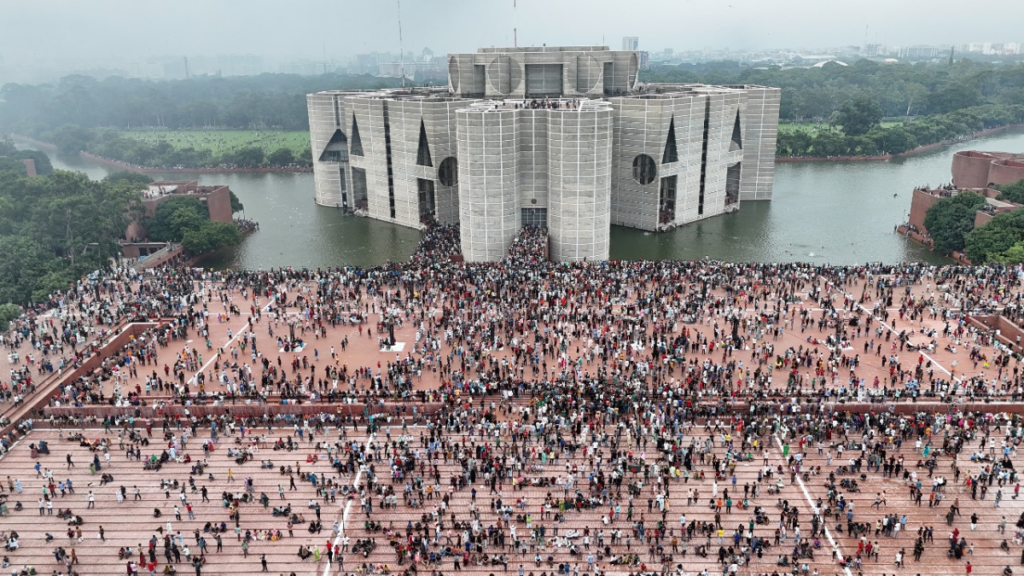
I never expected that a one-year stay in Bangladesh, from October 2023 to September 2024, would expose me to some of the darkest scenes of human conflict. I arrived as a young professional and a foreigner. But I left having witnessed firsthand how the breakdown of governance and the misuse of power can devastate the lives of regular individuals.
In July and August 2024, the country erupted in student-led protests. Each morning, I read the newspaper as the situation worsened, with students being killed, police under attack, crowds fighting back, and the death toll rapidly increasing. Initially a protest against unfair public service recruitment, it evolved into a broader expression of anger towards corruption, inequality, and long-standing suppressed grievances. For countless young people, it was more than a political movement; it was a desperate, collective cry for dignity and justice.
In the last weeks of the power breakdown, everyday routines became unrecognizable. The office shut down. Electricity vanished. Internet services were blocked. Markets closed early. ATMs stopped working. In that uncertainty, I was grateful to have a supportive director and colleagues who looked after me when the world outside felt increasingly unsafe.
On 5 August, everything changed. That afternoon, Sheikh Hasina resigned and fled the country. Almost instantly, people flooded the streets, some celebrating, others seeking revenge. Senior politicians, local leaders, and police officers became targets. Houses burned. Properties were destroyed. Lives were taken. Nearly 100 people were killed that day alone, including 13 police officers. In Faridpur, where I resided, between 8 and 10 individuals lost their lives.
That evening, the unrest reached my doorstep. A crowd gathered in front of my building and set fire to a shop owned by a politician. I watched the flames from my window, trying to understand how quickly order had turned into chaos. Soon after, a group of men came to my flat, knocking on my door and asking whether I had been filming the burning shop. They checked another room as well. In that moment, I knew that admitting to any recording could put me in danger. The air felt heavy, thick with fear, distrust, and a sense that society itself was gasping for breath, suffocated by the violence unfolding around us.
Now, with the recent death sentence handed to former Prime Minister Sheikh Hasina on corruption charges, global attention has once again turned toward a nation in turmoil. But for me, the story goes far beyond politics. It is about people, their pain, their courage, their fragility, and their hope.
It is, above all, profoundly human.
Root Causes of Unrest
The unrest began in July–August of 2024, when students initiated protests that quickly spread across campuses and cities. What started as a demand for fair public service recruitment escalated into a nationwide uprising. Angry young voices spoke not just about quotas but also about disillusionment with governance, corruption, and a system that seemed to prioritize the powerful over the people.
Hasina had led Bangladesh for 15 years. Critics accused her government of using patronage, consolidating power, and suppressing dissent. For many, the protests were not just about a quota system; they were about a broader failure of governance and a deep frustration that power had become unaccountable.
The Trial and Death Sentence
In response to the uprising, Bangladesh’s International Crimes Tribunal (ICT) opened a case against Hasina. The tribunal accused her of abetment, incitement, complicity, failure to prevent mass murder, and giving orders that led to violence.
The court, after months of hearings, delivered a verdict: a death sentence in absentia. The trial was fast-paced, and she was not present; she remains in exile in India. The tribunal also convicted two of her aides: former Home Minister Asaduzzaman Khan Kamal was also sentenced to death, and the ex-police chief, Al-Mamun, was given five years.
The charges were severe:
- Crimes against humanity,
- Deaths of protesters,
- Incitement and complicity,
- Use of lethal force,
- Failure to protect citizens.
Her sentencing to death has split opinions; some see it as justice, others as political revenge. But what is undeniable is that the nation paid the price long before the verdict was delivered.
Hasina criticized the tribunal from her secure residence in India, labeling it a “biased court” engaged in political theatrics. She argued she was never given a fair defense, and that the charges were motivated by her political opponents. In her statement, she claimed that while there was unrest, it was not part of a premeditated plan to massacre citizens.
These fundamental questions arise: Is the focus on justice or revenge? Moreover, does the tribunal aim for truth or is it a tool for political retaliation?
Despite the risks, the students persisted. They organized, chanted, and marched. Their courage was remarkable. Many paid the ultimate price, injured, imprisoned, or killed. Those who survived carried their pain into courtrooms, testimonies, and public memory.
Civil society groups and international observers meticulously documented the events, gathering evidence, documenting human rights abuses, conducting postmortems, and compiling witness accounts.
Lessons in Leadership and Accountability
This episode is a tragic lesson in leadership. Power without accountability can destroy lives. A leader must listen, empathize, and protect, not just rule. Hasina was once a symbol of stability, but critics say she became a symbol of unchallengeable authority.
On the other hand, the interim administration and tribunal face their own test: they must administer justice fairly. If justice becomes political, it loses moral worth. True leadership would demand transparency, impartiality, and the protection of human rights, even for the accused.
Lessons Learned
- Power needs checks: Institutions of justice must be independent.
- Citizens’ voices matter: Even in fear, people must speak.
- Leadership demands humility: Leaders should view dissent not as a threat but as valuable feedback for growth.
- Fundamental: The right to protest, to life, and to dignity are fundamental; human rights are non-negotiable.
- International attention helps: Global observers, advocacy, and documentation play a crucial role in amplifying the suffering of the vulnerable.
Conclusion
My experience in Bangladesh that tumultuous year revealed a profound truth: while unbridled power is frightening, the unity and courage of individuals are formidable, demonstrating the resilience and solidarity of communities. The tribunal’s verdict goes beyond a political reckoning; it embodies a human narrative of loss, such as the sacrifices made by the students, courage in the face of violence, and the relentless pursuit of justice despite personal risks, depicting the raw emotions and challenges experienced by individuals.
I may have been just a foreigner in that land, but I felt its pain deeply, resonating with the shared emotions of the community. I saw how easily basic needs, electricity, communication, and safety can be disrupted when governance fails. And I witnessed how ordinary people, especially the youth, bravely dared to demand freedom, such as organizing peaceful protests in the face of violence, showcasing their remarkable courage in the face of adversity.
If justice prevails, it will be about more than just punishment; it will be about the reconstruction of institutions, trust, and the social contract between a state and its people. This hope I hold is intricately woven into the narrative I feel the world must listen to, highlighting the profound influence of hope within stories and motivating unified efforts towards justice and accountability.