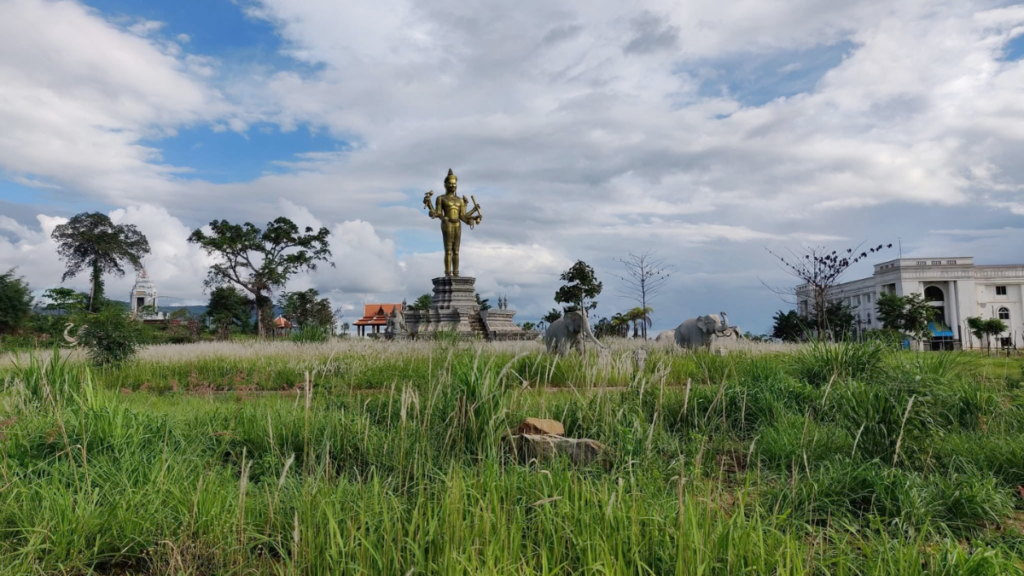
The demolition of a statue of Lord Vishnu in the Anses area of Cambodia’s Preah Vihear province by the Thai army has raised serious concerns about the safety of cultural and religious heritage amid the Cambodia–Thailand border conflict. While the incident triggered diplomatic reactions within the region, it also drew strong attention in India, where many viewed the destruction not as a local border issue but as an attack on shared civilizational heritage linking South and Southeast Asia.
The response was swift. India’s Ministry of External Affairs (MEA) described the demolition as “deeply concerning,” stressing that territorial disputes must not lead to damage to religious or cultural symbols. Cambodian authorities also strongly condemned the act, calling it a violation of cultural and religious values and reaffirming that sacred sites must not become targets during military confrontation. In Thailand, the incident sparked debate after caretaker Prime Minister Anutin Charnvirakul said a destroyed statue “cannot be compared with the limbs our soldiers have lost,” a remark critics saw as dismissive of cultural heritage. Veteran journalist Pravit Rojanaphruk warned that such thinking risked a society becoming “war-drunk” and damaging Thailand’s international standing.
The implications extend beyond politics. India is one of Thailand’s most important tourism markets, with over 2.12 millionIndian visitors in 2024 and around 1.77 million in the first nine months of 2025
Conflict and cultural loss
These events occurred during 20 days of fighting, from 7 December until an immediate ceasefire took effect at noon on 27 December 2025. Cambodian authorities reported repeated air strikes, including the use of F-16, Gripen and T-50TH jets, reaching more than 70 kilometres inside Cambodian territory, including areas near Siem Reap. The escalation caused dozens of deaths and mass displacement on both sides of the border. Cambodia reported more than 30 civilian deaths, around 90 injuries, and nearly 646,000 people displaced across six provinces, along with the closure of over 1,000 schools affecting more than 250,000 students. Thai officials also confirmed civilian and military fatalities, with at least 65 people killed and more than 150,000 evacuated from border districts.
The ongoing conflict has had a huge effect on Hindu temples and cultural heritage, especially in areas where the borders are still in dispute. Military operations are putting places like the 11th-century Preah Vihear temple, which is a UNESCO World Heritage site, in danger. Since the conflict in 2008, threats and damage have grown, and fights in July and December2025 have made things worse, leading UNESCO to issue urgent appeals. Another important temple, Prasat Ta Krabei, has also been affected. These examples show how modern warfare is putting ancient Hindu heritage at greater risk, as historical sites are damaged in territorial disputes.
India’s consistent stand on heritage protection
India’s reaction to the statue’s destruction was in line with its diplomatic policy. Earlier in December, the MEA had already expressed concern about reports of damage to Preah Vihear’s conservation infrastructure. They stressed that territorial disputes should never be used as an excuse to harm cultural or religious heritage. New Delhi has repeatedly stressed that all parties must protect sacred sites and has asked both Cambodia and Thailand to be careful and make sure they are safe during times of conflict.
This position is reinforced by India’s long-term and tangible commitment to heritage preservation in Cambodia. At the request of the Cambodian government in 1980, India became the first country to offer assistance in the restoration and conservation of the world-famous Angkor Wat temple in Siem Reap, following the fall of the Khmer Rouge, marking a landmark moment in bilateral cultural cooperation. According to MEA, this initiative laid the foundation for sustained Indian engagement in Cambodia’s heritage sector, including the work of the Archaeological Survey of India (ASI) at Angkor and later conservation efforts at Ta Prohm, Preah Vihear, and other Hindu temple sites.
The Khmer Empire and shared civilization
To understand why this matters, one must look to history. The Khmer Empire’s successor, Cambodia, ruled most of mainland Southeast Asia from the 9th to the 15th centuries CE. This included present-day Cambodia, Thailand, Laos, and parts of Vietnam. During this time, Khmer kings built thousands of temples for Hindu and later Buddhist gods. They used Shaivite, Vaishnavite, and Buddhist ideas to do this.
Angkor Wat, Preah Vihear, Ta Prohm, and many other lesser-known shrines are examples of Indic political theology, cosmology, and ritual practices. These buildings show how rich the culture is. They create a sacred geography that existed before modern nation-states and still has cultural and spiritual significance today.
Beyond faith and diplomatic responsibility
For India, where nearly 80 percent of the population identifies as Hindu, attacks on Hindu symbols abroad carry emotional weight. But the problem goes beyond feelings. Cultural diplomacy has become an increasingly important dimension of foreign policy. In a world where identity and history shape geopolitics, defending heritage is as strategic as economic or security engagements.
India’s public statements and restoration projects show that they care about more than just the symbolic. They are a conscious attempt to explain and defend a set of beliefs: that cultural heritage cannot be replaced once it is lost and that sacred sites, whether Hindu, Buddhist, or otherwise, should be protected in times of peace and war.
Conclusion
Border disputes will continue; geopolitical tensions are part of the modern world. But once cultural monuments like temples, statues, and other buildings are destroyed, they can’t be rebuilt. India must always stand by the principle that faith and heritage should not be harmed by conflicts if it wants to be a civilizational power and a strategic player. This means that cultural symbols must be protected.
The events at the Cambodia–Thailand border remind us that this principle is no longer just a theory. It is both urgent and useful. India’s steady, calm involvement through diplomacy, cultural preservation, and public expression of shared values is a good example of how a responsible nation can respond when its heritage and the faith it represents are in danger.
The original version of this article first appeared in Cambodianess: https://cambodianess.com/article/why-the-destruction-of-a-hindu-statue-matters-to-cambodia-india-and-thailand