A decade of war and humanitarian crisis has cratered Yemen’s education system for girls.
In June 1964, Malcom X said, “Education is our passport to the future, for tomorrow belongs to those who prepare for it today.”
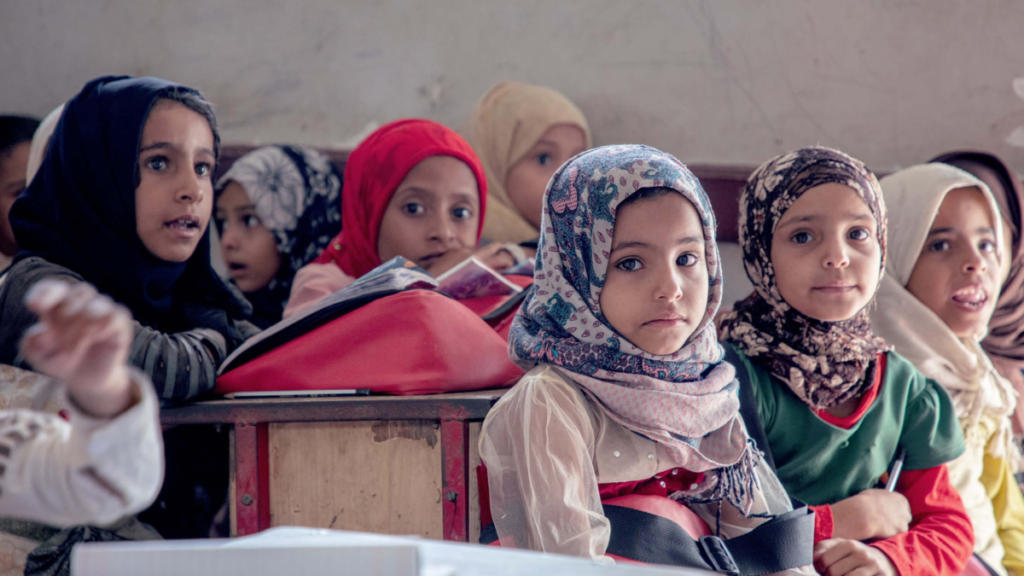
In Yemen, that passport to the future has been lost in the ashes of war, and generations have been lost amid the rubble of schools and the sounds of bombing. Between 2015 and 2025, education has transformed from a human right into an unattainable luxury, especially for girls, who pay the price in a conflict.
Due to mounting economic pressures, child marriage has increased; the rates remain around 30%, as families attempt to alleviate insecurity and poverty.
The Yemeni conflict began in March 2015, and with it, the gradual collapse of the country’s education system. The United Nations Children’s Fund (UNICEF) indicates that as at 2024, more than 11 million children are in need of educational assistance, with around 3.2 million being completely out of school. The Yemen Teachers Syndicate, an affiliate of Education International, notes that widespread strikes are occurring as teachers protest unpaid or underpaid salaries, forcing many of them to leave the profession for alternative livelihoods. A survey conducted in October 2022 revealed that at least one in four schools is unfit for use.
Yousra, a 16-year-old displaced girl from Taiz, was married at the age of 12 and became a mother of two daughters by 13, illustrating the profound challenges encountered by girls in Yemen. She has always regretted not having had the opportunity to attend school. “I studied until the fifth grade,” Yousra said. “But I couldn’t read or write, and I didn’t continue. I felt bad.” A Malala Fund report card found that approximately 68% of girls in upper secondary years in Yemen are out of school. More than 70% of children in grades 2 and 3 lack basic numeracy skills. Due to mounting economic pressures, child marriage has increased; the rates remain around 30%, as families attempt to alleviate insecurity and poverty.
Over the past decade, classrooms have moved into hallways and stairwells when schools remain standing; bombing and conflict have damaged or rendered unusable more than 3,400 schools. A UN-brokered ceasefire, officially declared to have ended in 2022, did not restore safety or stability for most students. According to a Save the Children Fund survey, about 76% of students say their sense of safety has not improved, and 14% cite violence as a direct cause of dropping out. Economic collapse makes education unaffordable for 20% of families, with monthly school fees and textbook costs prohibitive for roughly one in five households. Yemen’s population endures a two-thirds poverty rate, with 4.5 million people displaced, many repeatedly. A family of seven faces a typical monthly food bill of $85, a burden that often compels children to forego schooling to support dependents. Teachers, the backbone of education, face parallel hardship. More than 170,000 teachers have not received regular salaries for four years.
“Every classroom that reopens strengthens peace; every girl who returns to school weakens the grip of war.”
Initiatives such as UNICEF Yemen’s Education in Emergencies project aims to sustain a foothold for learning even amid the chaos. Public education enrolment has demonstrated resilience, with approximately 7.5 million students enrolled across various educational levels in the 2021–22 academic year, including 252,000 in literacy and alternative education programs. UNESCO notes that education continues to receive only a small share of humanitarian funding – around 2.3% on average from 2014 to 2022, peaking in 2019 and waning sharply by 2022. Despite funding gaps, education persists as a critical objective within humanitarian and development agendas.
However, the ongoing conflict in Yemen fuels the politicisation of education. Schools in some areas of the country are used to recruit children, indoctrinate youth, promote sectarian ideologies, and even serve as military training venues. In 2018, a senior Houthi military official claimed that there were 18,000 child soldiers in its army. Meanwhile, schools also remain physically unsafe spaces to be: during the course of the conflict, there have been 52 reported attacks on schools by various parties, and violence disrupts attendance and erodes trust in the safety of educational spaces.
Every classroom that reopens strengthens peace; every girl who returns to school weakens the grip of war. Donors should collaborate with non-governmental organisations and local governments to finance the rebuilding process. The priorities should encompass repairing damaged schools, retaining and recruiting teachers through incentives (with a specific focus on enhancing girls’ enrolments), conducting campaigns to deter student dropout rates, and supplying Arabic-language tablets to students through collaborations with technology firms. This approach recognises education as crucial for rebuilding Yemen’s identity and future, not as a luxury but as a fundamental necessity. In Yemen, this passport needs to be renewed not with guns or threats, but with education and the strong belief that every child should have the chance to learn.
This article first appeared in The Interpreter, published by the Lowy Institute. https://www.lowyinstitute.org/the-interpreter/yemen-s-generation-without-classrooms