Armed clashes along the Cambodia–Thailand border in late July 2025 showed once more how fragile peace is in Southeast Asia. According to Save the Children, over 1,200 schools in both countries, including Oddar Meanchey, Preah Vihear, and Surin provinces, were closed because artillery fire and the fighting forced 134,000 people to leave their homes in Cambodia. The violence resulted in the deaths of civilians, halted essential services, and significantly disrupted education.
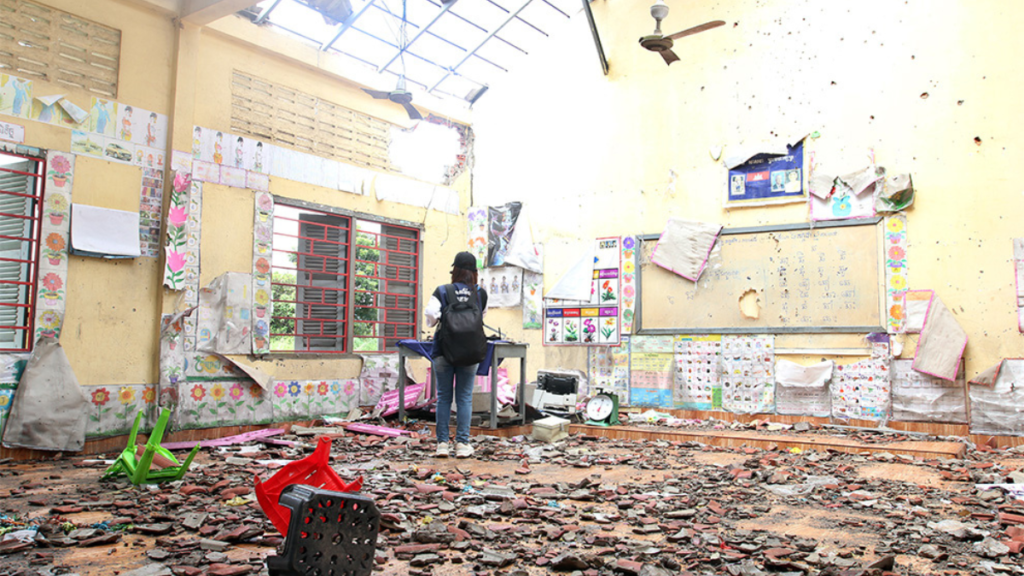
In addition to damaging classrooms and causing exam disruptions, Cambodian students in Thailand faced harassment as a result of the conflict. Many individuals were compelled to return home against their wishes, abandoning their studies abroad. Disputes over the Cambodia–Thailand border have been ongoing for decades, with numerous instances where educational opportunities were stripped away from an entire generation, highlighting the exacerbation of inequality by conflict.
According to the Cambodian Ministry of Education, the closure of 605 schools in five provinces impacted 15,000 students and over 6,000 teachers. The national high school exams that were supposed to happen in mid-August were put off for safety reasons. Authorities in Thailand closed 751 schools near the border as a precautionary measure due to the conflict. These closures were precautionary, but they showed how scared the community was.
The disruption got worse because of the displacement. Over 50,000 Cambodians, including 6,500 children, stayed in camps as a result of the conflict. UNICEF and World Vision set up temporary classrooms and support, but most missed weeks of school, increasing dropout risk.
The risks for Cambodian students in Thailand went beyond just feeling unsafe. Reports of anti-Cambodian speech spread online and in local communities, leading to harassment and exclusion. By August, at least 600 Cambodian students had gone back home, saying that discrimination was their main concern.
The results were terrible. Rights monitors reported that a Cambodian teenager in Thailand took her own life after facing isolation from her peers, who associated her identity with the border conflict. In another case, Thai police arrested a 13-year-old Cambodian boy during an immigration raid, which child rights groups condemned. One student said they felt “trapped between borders” because they couldn’t go to school in Thailand and didn’t know if their credits would be accepted back home.
This hostility also undermines the Association of Southeast Asian Nations (ASEAN)’s cross-border education exchanges.
The conflict showed once more how weak ASEAN is at resolving disputes. The High Council of the organisation, which is mandated to assist in conflict resolution as per the Charter, remains inactive in addressing the ongoing disputes. The fighting in late July stopped only after Malaysia helped arrange a ceasefire, which was backed by outside powers like the US and China. But the real problems that cause the flare-ups to happen over and over again are still not being dealt with.
On 26 October 2025, Cambodia and Thailand signed a peace-deal declaration in Kuala Lumpur. The agreement—witnessed by the President of the United States and the Prime Minister of Malaysia—committed both sides to withdraw heavy weapons, engage in humanitarian de-mining, restore diplomatic channels and expand cooperation along the border.
However, the fragile progress unravelled quickly. On 12 November, Thailand announced its unilateral withdrawal from the agreement. That same day, a Cambodian civilian was killed and villagers in Banteay Meanchey were evacuated following renewed shooting along the border. These events highlight how unstable the situation remains, despite official ceasefire commitments.
For families living in border districts, the return of violence has reignited fears of another wave of displacement and school closures. For students already traumatised by months of interruption, these renewed tensions heighten uncertainty about their safety, learning and long-term prospects.
The July–November events show that without regional protocols, students remain dangerously vulnerable. Education cannot be treated as an afterthought in conflict settings—it must be integrated into security planning. There should be “Education-Safe Zones” along the border to protect schools.
The zones should be set up along the border as safe places where schools, teachers, and students are safe from violence and political interference. The Schools as Zones of Peace (SZOP) programs in Afghanistan, Nepal, and Somalia are good examples of how to build strong community ownership and get local actors to promise to respect schools as safe, non-military spaces. These experiences demonstrate that when education is utilised as a peacebuilding instrument, it not only preserves learning amid conflict but also promotes reconciliation and trust within fragmented communities.
To ensure continuity of learning within these zones, governments and partners should deploy mobile classrooms, hybrid teaching models, and cross-border credit recognition systems. The European Erasmus framework, through its European Credit Transfer and Accumulation System (ECTS) and blended learning programs, shows that regional cooperation can keep educational mobility going even in times of crisis. Some examples are Digicel’s solar classrooms in Haiti, Peru’s mobile “Amazon vans” and Indigenous tech programs, India’s EduBridge app, Kenya’s solar “Classroom in a Box,” and modular schools in FloridaandCalifornia. These models show how education that is modular, mobile, and uses technology can keep people learning during times of crisis or change.
Lastly, to stop educational disruption and protect students from discrimination and abuse, bilateral and regional cooperation must put human rights accountability first. The ASEAN Intergovernmental Commission on Human Rights (AICHR) should be in charge of making sure that everyone has the right to an education and that anti-discrimination rules are followed. Integrating education protection into human rights discussions will turn political promises into enforceable protections. This will create a regional framework where schools stay safe, welcoming, and rights-based institutions even when there is conflict.
In this context, Save the Children and other humanitarian organisations have been advocating for increased investment in mobile learning units, teacher training for emergency response, and digital learning platforms to sustain education during crises. Their efforts support AICHR’s mission by connecting the protection of human rights with practical ways to make sure that education continues and people are strong during emergencies.
As of mid-November 2025, the border situation remains tense despite attempts at negotiated peace. For thousands of students whose learning has been repeatedly disrupted, the psychological and academic impacts may last far longer than the conflict itself. Each missed exam, each forced return and each unsafe classroom contradicts ASEAN’s vision of a shared future built on integration and human capital.
In Southeast Asia’s border flashpoints, school safety is non-negotiable: ignore it, and you sabotage youth potential and shatter lasting peace.
This article first appeared in the Devpolicy Blog, published by the Development Policy Centre. You can read the original version: https://devpolicy.org/borderline-classrooms-education-at-risk-in-southeast-asia-20251114/