On 28 August 2026, delegates gathered at the GDT Convention Centre in Phnom Penh formally adopted the Phnom Penh Declaration, closing out the three-day Second Inter-Parliamentary Speakers’ Conference (ISC-2). The text reaffirms international law, peaceful dispute settlement and “stronger parliamentary diplomacy” in language that is broad, aspirational and, in places, familiar to any reader of a multilateral communiqué. The real question the conference leaves behind is not whether such language was adopted — it was, unanimously and without apparent controversy — but whether parliamentary diplomacy of this kind can do more than produce it.
Phnom Penh as a diplomatic stage
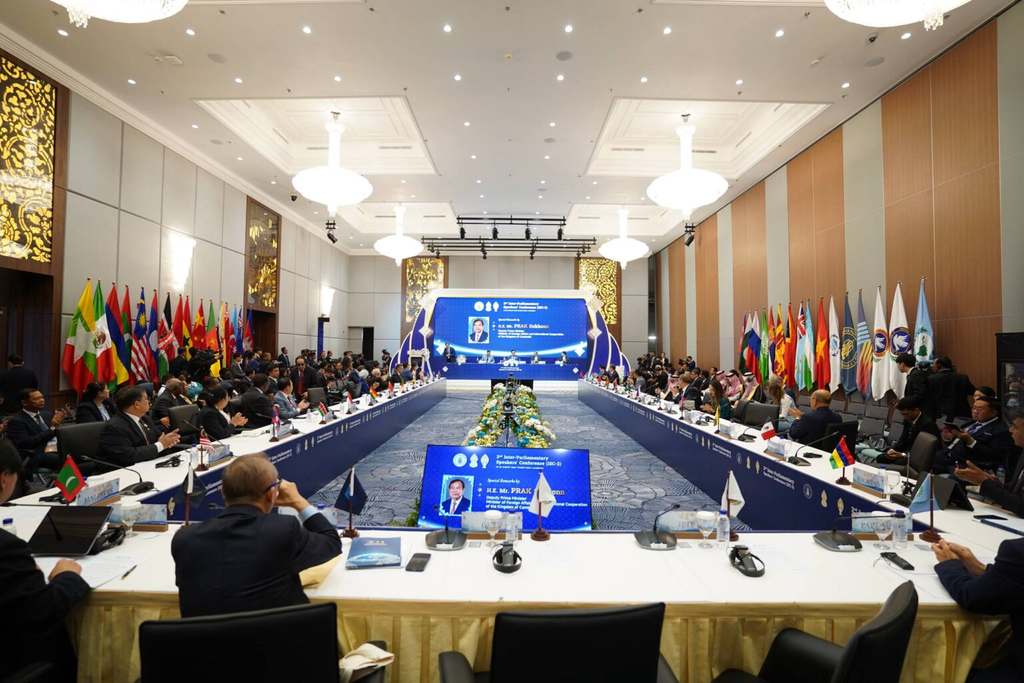
Held under the theme “Solidarity for Peace and Shared Prosperity: Strengthening International Law and Resolving Conflicts Peacefully,” ISC-2 brought together roughly 130 delegates representing 26 countries and five international organisations, jointly hosted by Cambodia’s Senate and National Assembly. It was the second edition of a forum established only in 2025, chaired by Senate President Hun Sen alongside ISC founding president Syed Yousaf Raza Gillani, Chairman of Pakistan’s Senate, with Prime Minister Hun Manet delivering the keynote and National Assembly President Khuon Sudary presiding over the closing session. For a young, still-institutionalising forum, simply reassembling speakers and senior parliamentarians from six continents in Phnom Penh — with a royal message from King Norodom Sihamoni framing the gathering — was itself the conference’s first achievement: a demonstration that the ISC has survived its founding year and can still draw a room.
What the Phnom Penh Declaration actually says
Stripped of its ceremonial framing, the declaration is a six-part political statement, not a treaty. Its most consequential commitments cluster in Section II, where participating parliaments pledge to uphold the UN Charter, support “dialogue, consultation, negotiation, mediation, and other peaceful means” for resolving disputes, and — notably — strengthen parliamentary diplomacy as “an important instrument for confidence-building, conflict prevention, dialogue, reconciliation,” including support for preventive diplomacy before tensions escalate. This is a more specific ambition than boilerplate multilateralism: it frames parliaments themselves as conflict-prevention actors, not merely as venues for ratifying what executives negotiate. Section III’s human-security agenda — food, energy and health security, climate resilience, secure supply chains, digital transformation, interfaith dialogue — is broader and less binding, closer to a shared checklist than a set of obligations. The Way Forward and Future Development sections are the most operationally minded: they task the ISC Secretariat and founding members with expanding membership and building “practical, inclusive, flexible” institutional arrangements, and they formalise Indonesia’s House of Regional Representatives as host of ISC-3 in 2027. That succession commitment matters more than it might appear — it is the clearest signal that participating parliaments intend the ISC to persist as a recurring institution rather than a one-off gathering.
The rise — and limits — of parliamentary diplomacy
Parliamentary diplomacy occupies a distinct niche alongside executive-branch statecraft. Legislators can build cross-party and cross-national relationships insulated, to a degree, from the immediate pressures facing foreign ministries; they can normalise dialogue between states whose governments are not yet ready for formal negotiation; and forums like the ISC, the Inter-Parliamentary Union or AIPA allow smaller and middle-power states disproportionate visibility relative to their weight in traditional diplomacy. ISC Secretary-General Ek Nath Dhakal captured both the appeal and the ceiling of this model when he told reporters at ISC-2 that the organisation does not intervene directly in conflicts but “provides a platform for dialogue among parliamentary leaders and representatives.” That is an honest description of what parliamentary diplomacy can offer: relationship-building, agenda-setting and moral pressure — not enforcement, mediation with teeth, or binding dispute resolution. Parliamentarians rarely control their governments’ foreign policy, and a declaration adopted by consensus among dozens of delegations is, almost definitionally, calibrated to avoid anything a participating government would object to. That is precisely why such declarations tend toward the general.
Why this matters for Southeast Asia
The conference did not occur in a vacuum. It convened as ties between Cambodia and Thailand remain strained following deadly border clashes and Thailand’s withdrawal from a long-standing framework for negotiating overlapping maritime claims in the Gulf of Thailand — a dispute Cambodia has since pursued through compulsory conciliation under UNCLOS. Hun Sen used his opening remarks to accuse Thailand of what he called “discredit warfare,” and Deputy Prime Minister Prak Sokhonn told delegates that Cambodia has chosen negotiation and international legal mechanisms over force. These are Cambodia’s characterisations, not independently adjudicated facts, and Thailand’s own position was not represented at a conference Cambodia hosted and chaired. What the episode illustrates is less about who is right than about the declaration’s relevance: its emphasis on non-interference, peaceful settlement and rejecting the use of force speaks directly to the kind of dispute Cambodia is currently litigating, which is also why independent observers noted the timing was unlikely to be coincidental.
From declaration to implementation
A declaration is a political commitment, not a binding instrument — it creates no enforcement mechanism, and nothing in the text obliges any parliament to act. Cambodian analyst Seng Vannly’s assessment, offered in the conference’s aftermath, is a useful corrective to enthusiasm: hosting ISC-2 strengthens Cambodia’s diplomatic standing and builds an international environment favourable to law-based solutions, “but it has its limits.” Translating Section IV’s pledges — legislative exchange, capacity-building, improved coordination and follow-up — into substance will require the ISC Secretariat to build durable machinery: a standing mechanism for tracking commitments, structured parliamentary exchanges between conferences rather than only at them, and some form of the “international network of parliamentary mediators” Hun Sen himself floated. Indonesia’s confirmed hosting of ISC-3 in 2027 is a modest but real test: institutional continuity across hosts, rather than a single successful conference, is what would distinguish the ISC from a recurring photo opportunity.
Conclusion
Whether parliamentary diplomacy becomes more than a forum for statements depends on what happens between conferences, not during them. The Phnom Penh Declaration commits participating parliaments to little that is legally enforceable, and its language, read alone, changes nothing. Its value — if it has one — lies in whether the ISC Secretariat and its member parliaments build the follow-up architecture the declaration merely gestures toward. On that count, ISC-2 has bought the forum time and visibility, not yet a track record.
Sources
- “Phnom Penh Declaration”, adopted at the Second Inter-Parliamentary Speakers’ Conference (ISC-2), Phnom Penh, 28 August 2026.
- CamboJA News, “Global Parliamentary Conference Adopts Phnom Penh Declaration on Peace, International Law”, 28 August 2026.
- CamboJA News, “Hun Sen Brands Thai Border Actions ‘Discredit Warfare’ at Parliamentary Conference”, 27 August 2026.
- Agence Kampuchea Presse (AKP), “Cambodia Hosts ISC-2, Adopts Phnom Penh Declaration for Peace and Shared Prosperity”, 29 August 2026.
- Agence Kampuchea Presse (AKP), “ISC-2 Participants Call for Peaceful Settlement of Disputes and Stronger Parliamentary Diplomacy”, 28 August 2026.
- Agence Kampuchea Presse (AKP), “ISC-2 Delegation Praises Cambodia’s Successful Hosting of Parliamentary Speakers’ Conference”, 28 August 2026.
- Phnom Penh Post, “Sokhonn Addresses Thai Delays, Urges Resolution to Border Dispute”, 28 August 2026.
- The Khmer Today, “Phnom Penh Declaration Adopted at 2nd Inter-Parliamentary Speakers Conference”, 28 August 2026.
- AIPA Secretariat, “On 26–28 August 2026, the 2nd Inter-Parliamentary Speakers’ Conference (ISC-2) was convened in Phnom Penh, Kingdom of Cambodia”, 26–28 August 2026.
- Senate of Cambodia, “General Information – 2nd Inter-Parliamentary Speakers’ Conference (ISC-2)”, 2026.
- United Nations, “Charter of the United Nations”.
- International Crisis Group, “CrisisWatch”, 2026.
- RANE/Stratfor Worldview, “Thailand and Cambodia Maintain an Uneasy Ceasefire”, 4 August 2026.
- Al Jazeera, “Cambodians Struggle with Displaced Lives amid Tense Ceasefire with Thailand”, 9 May 2026.