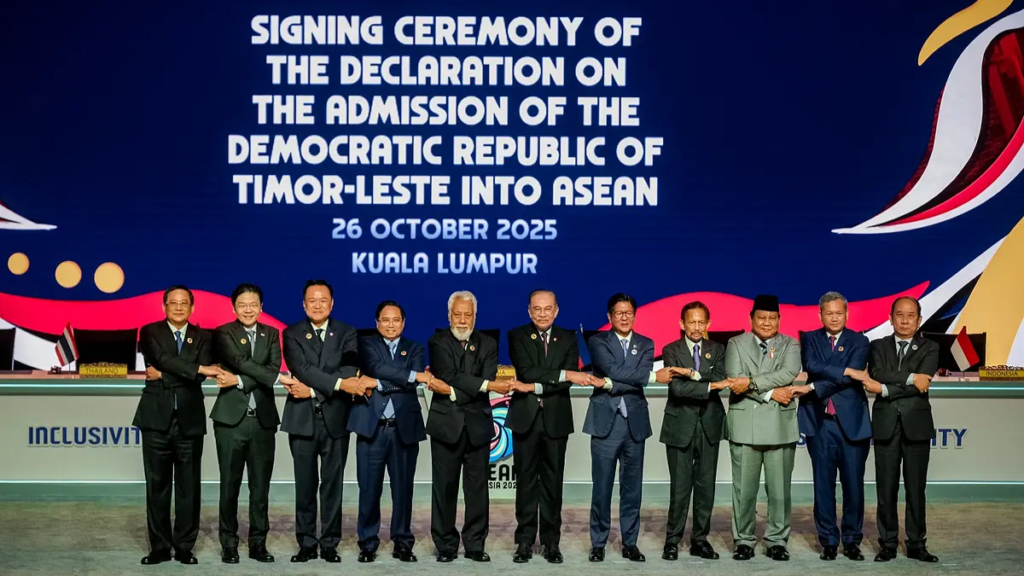
On 26 October 2025, leaders at the ASEAN Summit officially welcomed Timor-Leste as the 11th member of the Association of Southeast Asian Nations. This was a historic moment for both the young country and the regional group. For Timor-Leste, it is the realization of a long-held dream to be part of its Southeast Asian family. For ASEAN, this is a symbolic moment of regional completeness and a reminder that diversity can be both a strength and a weakness.
A Long Road to the ASEAN Table
Timor-Leste has been waiting a long time to join ASEAN. Dili asked to join ASEAN in 2011, nine years after it became independent from Indonesia. The application sat for years because ASEAN leaders couldn’t agree on whether the new country was ready for the demands of membership, even though it was geographically and culturally linked to the region.
ASEAN gave Timor-Leste observer status in 2022, and then they laid out a plan for full membership. This formal inclusion today is the end of that process and a strong sign of ASEAN’s commitment to regional unity and inclusion.
Indonesia, which has been one of Timor-Leste’s strongest supporters, was a big part of making this happen. Jakarta saw Dili’s admission as completing the regional map and achieving the organization’s founding goal of representing all of Southeast Asia. This was because Jakarta was the largest member and a founding pillar of ASEAN.
Why Timor-Leste’s Membership Matters
It’s not just a symbol that Timor-Leste is included. It reaffirms ASEAN’s “centrality” at a time when competition between countries in the Indo-Pacific is getting stronger. ASEAN aims to present itself as a united and independent group by expanding its membership. This way, it can grow on its own terms, rather than having to deal with outside pressure.
The benefits are just as big for Timor-Leste. Joining ASEAN gives you access to trade, economic partnerships, and development cooperation. It gives the country the chance to take part in regional talks about security, climate change, and digital transformation—issues where working together can achieve much more than working alone.
Being a member will also give Timor-Leste a stronger voice in global forums, where it can help shape the future of the region with its neighbors.
Opportunities and Challenges Ahead
Even though people are hopeful, Timor-Leste’s entry into ASEAN won’t be easy. It is still one of the smallest and least developed economies in the region, relying heavily on oil money and help from other countries. Its infrastructure and ability to run things are still not up to par with those in the region.
By letting Timor-Leste join, ASEAN has taken on an implicit duty to help and empower its newest member. ASEAN will need to be able to give specific help in areas like governance, education, and digital connectivity for this expansion to be successful. The ASEAN Development Fund and partner programs from countries like Japan, Australia, and the EU will probably be very important in helping Timor-Leste keep its promises and get the most out of its membership.
For ASEAN, this growth also tests how well it can balance being open to everyone with getting things done. The bloc’s consensus-based model can make it take longer to make decisions, and adding a new member may make things even more complicated. But if handled well, it can also make ASEAN’s identity as a community stronger by helping all of its members grow together.
Completing the Southeast Asian Family
Timor-Leste’s joining is a proud moment for the region. For a long time, ASEAN has been seen as a model of peaceful cooperation in a region with a lot of different cultures. Now that all of Southeast Asia’s countries are finally represented, that vision feels more complete.
ASEAN’s soft power is also shown by the fact that a small, post-conflict country is included. Countries want to join not because of binding treaties or shared ideology, but because of the promise of partnership, stability, and belonging.
This moment also puts ASEAN to the test to see if it can live up to its ideals. It will take a lot of time and money to make sure that Timor-Leste doesn’t become an “unequal member.” The real test of ASEAN’s unity isn’t how many members it has, but how well they work together and support each other.
A Step Toward a Stronger ASEAN
ASEAN is under more and more pressure from outside sources, such as strategic competition in the South China Sea, economic uncertainty, and climate threats. Timor-Leste’s official membership comes at this time. In this light, the expansion is both a reason to celebrate and a call to action.
ASEAN can have more power in the world if it stays together and looks to the future. Bringing Timor-Leste into ASEAN successfully will send a strong message: that ASEAN’s strength comes from its ability to accept differences, support growth, and stay together even when things change.
Timor-Leste’s joining ASEAN is a chance for the group to remember its founding values of partnership, equality, and respect for each other. This new chapter isn’t just about geography; it’s also about reaffirming our shared commitment to making Southeast Asia a peaceful, welcoming, and strong place for the generations to come.