After seven days of escalating violence along the Cambodia–Thailand border, the return to calm began not on the battlefield, but through urgent phone diplomacy.
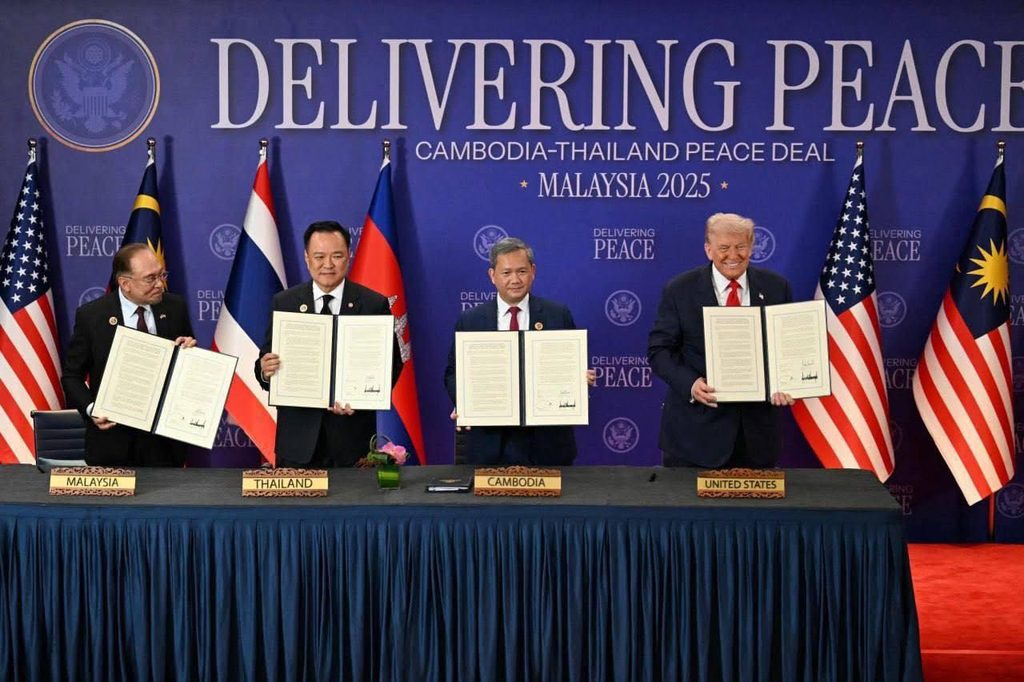
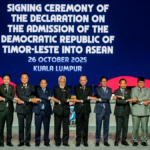
On the morning of December 12, 2025 (Washington time), U.S. President Donald Trump held separate phone calls with Cambodian Prime Minister Hun Manet and Thai caretaker Prime Minister Anutin Charnvirakul to reaffirm the peace accord reached on October 26. According to Trump’s social media statement, both sides agreed to stop the fighting and return to dialogue. Malaysian Prime Minister Anwar Ibrahim later confirmed his own calls with Phnom Penh and Bangkok, reinforcing ASEAN’s call for restraint. A mutual ceasefire was announced, set to take effect by the evening of 12 December (U.S. time), or early morning on 13 December in Bangkok and Phnom Penh (UTC+7). However, local media and statements from the Cambodian Ministry of Defence spokesperson reported that during these hours, Thai military operations expanded to Koh Kong province via naval forces. Additionally, Thai F-16 air operations struck infrastructure in Pursat province in the early morning of 13 December, raising serious concerns over compliance with the ceasefire.
The key question now is whether this diplomatic breakthrough can produce lasting peace, or whether agreements made by phone without credible monitoring and enforcement mechanisms will once again fail to prevent renewed violence.
Escalating Violence and Humanitarian Crisis
This round of clashes began on 7 December 2025, after rising tensions along disputed border areas that had already seen more than five days of fighting in July. The human cost is high. At least 23 people have been killed and up to 700,000 civilians displaced across Cambodia and Thailand. In Cambodia alone, officials report 11 civilian deaths, 76 injuries, and more than 274,000 people relocated to shelters. In addition, over 514 schools were closed, affecting 4,650 teachers and 129,106 students. If the violence continues, more lives may be lost, suffering on both sides will deepen, trust will collapse further, and fear and discrimination in stay long among both people and the nation.
Some analysts link the continued violence to Thailand’s domestic political situation. Following the dissolution of Thailand’s House of Representatives, authority has shifted largely to the military during a 45–60 day caretaker period. In this setting, analysts warn that military decisions may outweigh political restraint, increasing the risk that the conflict could continue or even worsen until a new government is formed.
Investigating Ceasefire Violations and the Settlement Line
Determining who violated the ceasefire remains a contentious and highly debated issue in the Cambodia–Thailand conflict. Both sides accuse each other of violating the agreed terms after a brief pause in fighting.
After earlier tensions, ASEAN-led discussions sought to define a provisional settlement line and encourage both militaries to stand down. However, troops remained deployed close to disputed areas, and the absence of a strong ASEAN civilian monitoring and verification mechanism meant violations could not be independently confirmed in real time.
As tensions continued, ASEAN Chair Anwar Ibrahim called on both sides to cease hostilities and halt deployments from 13 December 2025 at 22:00 (UTC+7), proposing the deployment of an ASEAN Observation Team (AOT) supported by satellite monitoring.
The Diplomatic Turn: Leaders’ Official Statements
As fighting intensified, diplomatic engagement moved quickly to public platforms and official statements.
U.S. President Donald Trump stated on Truth Social that he had spoken directly with the leaders of Cambodia and Thailand and that both sides agreed to stop the fighting and return to dialogue, signaling support for an immediate ceasefire.
Malaysian Prime Minister Anwar Ibrahim, acting as ASEAN Chair, publicly called on both sides to cease hostilities and halt military deployments, backing a ceasefire framework and proposing regional monitoring support.
Cambodian Prime Minister Hun Manet, in a Facebook post, thanked both leaders for their efforts toward peace and proposed an independent verification process. He stated that “the United States and Malaysia could use their information-gathering capabilities, including satellite imagery during and 24 hours after the clashes, to determine which side opened fire first”, emphasizing transparency and accountability.
In contrast, Thai caretaker Prime Minister Anutin Charnvirakul adopted a firm security-focused stance. Speaking to the media, he stated: “It’s definitely not a roadside accident. Thailand will continue to perform military actions until we feel no more harm and threats to our land and people. Our actions this morning already spoke.”
Establishing Lasting Peace Mechanisms with ASEAN, UN and US
A ceasefire alone is not enough. The fundamental issue lies not just in political will, but in the presence of weak institutions and enforcement mechanisms that falter when tensions escalate.
ASEAN’s existing civilian investigation and monitoring capabilities are insufficient in managing high-risk border disputes that involve conventional military forces. To prevent future clashes, it is imperative to take several key steps:
- ASEAN Monitoring Presence: ASEAN should consider deploying a neutral observer or monitoring team with a clear mandate to:
- Verify incidents on the ground
- Monitor settlement lines
- Report ceasefire violations objectively
- United Nations Peace Process and Technical Support: Cambodia is a long-standing contributor of peacekeeping troops to UN missions abroad. Yet conflict persists within its own borders. This contradiction strengthens the case for UN involvement, particularly in:
- Independent fact-finding and investigation
- Technical support for border demarcation
- Early-warning and confidence-building mechanisms
- The Role of the United States in the world order: The United States can play a supporting but important role. Beyond high-level diplomacy, Washington can contribute through:
- Satellite imagery and intelligence-sharing to verify ceasefire violations
- Technical support for monitoring and verification mechanisms
- Diplomatic pressure to ensure compliance by both sides
Without credible ASEAN monitoring, UN-backed verification, and coordinated international support, including that of the United States, future incidents will likely spiral out of control before diplomacy can respond. Lasting peace necessitates institutions that are robust enough to withstand challenges when tensions escalate.