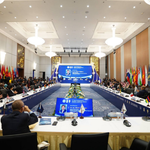
For three days in late August 2026, Phnom Penh became an unlikely meeting point for the world’s legislatures. Speakers and deputy speakers of parliament, senate presidents, and representatives of inter-parliamentary bodies converged on the Cambodian capital for the Second Inter-Parliamentary Speakers’ Conference (ISC-2), held from 26 to 28 August at the GDT Convention Centre. According to the Cambodian Senate, which organised the event, the Kingdom welcomed distinguished speakers, presiding officers, and representatives of inter-parliamentary and international organisations to the gathering. The event was not a summit of presidents or foreign ministers, but of parliamentary leaders — and that distinction matters more than it might first appear.
Why ISC-2 matters
ISC-2 is the second edition of a young forum. The Inter-Parliamentary Speakers’ Conference was established only in 2025, with its inaugural session held in Islamabad, Pakistan, that November under the theme “Peace, Security and Development.” Cambodia took part as a founding member. Its turn to host the second edition, less than a year later, placed it at the centre of a still-forming platform rather than an established institution — a distinction worth keeping in mind when assessing what the conference could realistically achieve.
The Phnom Penh gathering convened under the theme “Solidarity for Peace and Shared Prosperity: Strengthening International Law and Resolving Conflicts Peacefully,” bringing speakers of parliament, parliamentary leaders, and representatives of inter-parliamentary and international organisations together to discuss dialogue and cooperation in support of peace, stability, and respect for international law. That framing is deliberately broad, but it is also timely: a forum built around international law and peaceful dispute resolution convening in a region where a neighbouring border dispute had turned deadly within the past year is not incidental. By its conclusion, the conference had brought together roughly 130 delegates from around 30 countries, alongside inter-parliamentary and international organisations, according to Cambodia’s state news agency AKP.
Cambodia as host
Hosting ISC-2 is best read as a continuation of a deliberate Cambodian strategy rather than a singular achievement. Cambodian officials have framed the conference as another milestone in the country’s evolving diplomatic profile — from a recipient of international peacekeeping assistance to an active convener of high-level dialogue — pointing to Phnom Penh’s prior experience hosting ASEAN summits and Inter-Parliamentary Union meetings as evidence of its logistical capacity. That claim deserves scrutiny rather than acceptance at face value: convening capacity is not the same as diplomatic influence, and a well-run conference does not by itself translate into greater leverage on the issues Cambodia cares about.
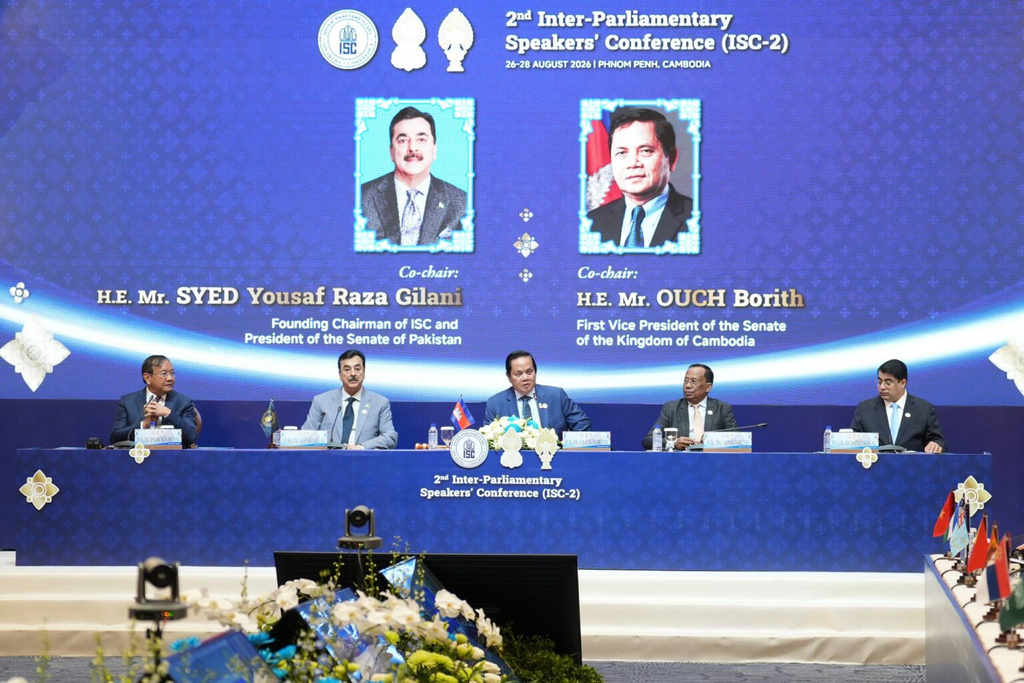
What the hosting role does confirm is that Cambodia’s parliament, not only its executive branch, has become an instrument of foreign policy. In practice, the conference blurred institutional lines: Senate President Hun Sen, who presides over ISC as a body, addressed the gathering alongside Syed Yousaf Raza Gillani, the forum’s founding president and chairman of Pakistan’s Senate, and Prime Minister Hun Manet, while the plenary was co-chaired by Senate First Vice-President Ouch Borith and Gillani. That blending of legislative and executive figures at a nominally “parliamentary” event is notable in Cambodia’s political system, where the line between party, government, and parliament is often thin — a fact worth weighing alongside the conference’s official self-presentation.
Parliamentarians and international diplomacy
Parliamentary diplomacy occupies a different register from summitry between heads of government. Speakers and legislators do not sign treaties or command militaries, but they carry distinct advantages: many hold long tenures that outlast electoral cycles in the executive branch, they can speak with a degree of political latitude that ministers bound by cabinet positions cannot, and they can build relationships across party and national lines that persist even when government-to-government channels cool. Vietnamese National Assembly Vice President Nguyen Thi Thanh, addressing ISC-2, affirmed the increasingly important role of parliamentary diplomacy amid what she described as a complex and volatile global landscape — a sentiment echoed by several delegations present.
That contribution should not be overstated. Parliamentary conferences generate declarations and goodwill, not binding commitments; speakers can voice support for international law without their governments necessarily altering behaviour on the ground. The genuine value of platforms like ISC lies in incremental functions — confidence-building through repeated contact, legislative exchange on how states domesticate international norms into national law, and an additional channel of communication that stays open when formal diplomatic ties are strained. More than 200 journalists reportedly covered ISC-2, a reminder that such conferences double as exercises in public diplomacy and national image-building.
Phnom Penh and Southeast Asia
The conference’s regional backdrop gave its theme added weight. Cambodia and Thailand fought deadly border clashes in 2025 that killed dozens and displaced hundreds of thousands of people on both sides before a fragile ceasefire, brokered with Malaysian and American involvement, took hold. Independent analysts have since described the truce as an uneasy one, noting that competing territorial claims, domestic politics, and stalled diplomacy have prevented broader normalisation between the two governments. Neither government’s account of the underlying dispute is treated here as settled fact; what is clear is that the unresolved tension gave a conference themed around peaceful conflict resolution a genuine, rather than purely rhetorical, regional relevance. It also illustrated the limits of parliamentary diplomacy: ISC-2 neither addressed nor resolved the Cambodia-Thailand dispute, which continues to be managed through separate bilateral and ASEAN-linked channels.
Beyond the conference
A single conference’s significance depends partly on what follows it. Cambodia’s closing declaration welcomed Indonesia’s agreement to host the Third Inter-Parliamentary Speakers’ Conference (ISC-3) in 2027, pledging support for the Indonesian Senate in carrying the platform forward. That handover arguably matters more than any single Phnom Penh session: a young forum’s credibility rests on whether it outlasts its founders and early hosts. Indonesia’s involvement, as Southeast Asia’s largest democracy with its own tradition of parliamentary and multilateral engagement, gives ISC a chance to broaden its base rather than remain closely identified with its first two hosts, Pakistan and Cambodia.
Conclusion
ISC-2 leaves Phnom Penh with a fuller diplomatic calendar entry, a modestly enlarged network of parliamentary contacts, and a declaration whose substance merits separate scrutiny. Whether the Inter-Parliamentary Speakers’ Conference becomes a durable fixture of international parliamentary life, rather than a sequence of well-attended but low-consequence gatherings, will depend less on any single host’s hospitality than on whether Jakarta in 2027, and hosts beyond it, can sustain the momentum and translate dialogue into practical legislative cooperation.
Sources
- Senate of Cambodia, “General Information – 2nd Inter-Parliamentary Speakers’ Conference (ISC-2)”.
- AIPA Secretariat, “On 26–28 August 2026, the 2nd Inter-Parliamentary Speakers’ Conference (ISC-2) was convened in Phnom Penh, Kingdom of Cambodia”, 26–28 August 2026.
- Agence Kampuchea Presse (AKP), “Feature: Phnom Penh Emerges as a Hub of Parliamentary Diplomacy Ahead of ISC-2”, 4 August 2026.
- Agence Kampuchea Presse (AKP), “ISC-2 Attracts More Than 200 National and International Journalists”, 27 August 2026.
- Agence Kampuchea Presse (AKP), “ISC-2 Delegation Praises Cambodia’s Successful Hosting of Parliamentary Speakers’ Conference”, 28 August 2026.
- Agence Kampuchea Presse (AKP), “Cambodia Hosts ISC-2, Adopts Phnom Penh Declaration for Peace and Shared Prosperity”, 29 August 2026.
- Vietnam News Agency (VNA)/VietnamPlus, “Vietnamese National Assembly Vice President Highlights Parliamentary Diplomacy at ISC-2”, 27 August 2026.
- Khmer Times, “Cambodia Prepares to Host Inter-Parliamentary Speakers’ Conference”, 20 May 2026.
- The Khmer Today, “Phnom Penh Declaration Adopted at 2nd Inter-Parliamentary Speakers Conference”, 28 August 2026.