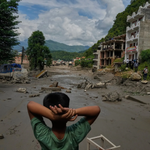
On the morning of August 26, 2026, a piece of the Langtang Lirung glacier broke away on the Nepal-China border. Within minutes, a wall of ice, rock, mud and water was moving down the Trishuli Valley at speeds later estimated at more than 190 kilometers per hour. It reached the Gyirong border crossing in Tibet in under seven minutes. Downstream in Nepal, it kept moving for hours, erasing villages, bridges, hydropower stations and a school.
By the time rescue teams could take stock, more than 1,000 people were confirmed dead across Nepal and China, with thousands more listed as missing. The final toll will not be known for weeks, perhaps longer. Some bodies were carried more than 200 kilometers downstream into India before they were recovered.
Numbers that size are almost impossible to hold in the mind. What is easier to hold — and what this article is about — is what happened in the minutes before the water arrived, in the handful of villages and one school where the difference between survival and loss came down to a warning, a decision, and how fast someone was willing to act on incomplete information.
This is not a comprehensive account of the disaster. It is the story of four decisions, made by four different people, in the same catastrophic hour.
Rajendra Dawadi was teaching a class at Tribhuvan Trishuli Secondary School in Nuwakot district when a colleague ran in with a warning: floodwaters were tearing through the Trishuli Valley, destroying homes and bridges. Moments later, another teacher received a similar warning by phone. Then a parent arrived at the school gate to pull her child out early.
One decision, 1,600 lives
None of this amounted to an official alert. There was no siren, no formal evacuation order from a district authority. Dawadi had, by his own account, only fragments of information and very little time. He rang the school bell anyway and ordered everyone out toward higher ground.
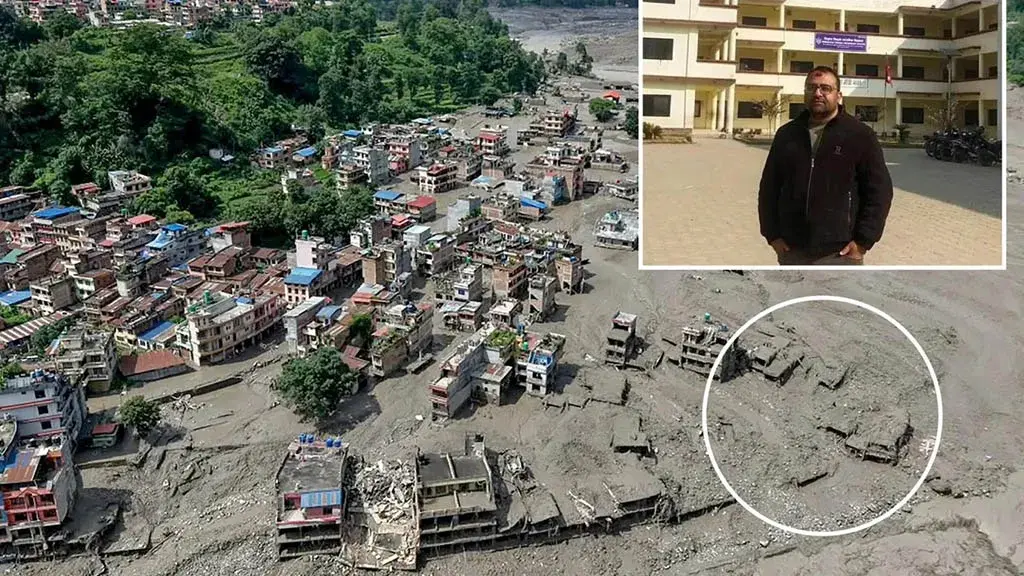
“I immediately decided to stop … school” and get the children out, he later told the Associated Press.
The school had 1,643 students enrolled. Roughly 900 were on campus that morning; others were still on their way. Dawadi told his staff to move those already there uphill, and he phoned bus drivers who were en route, telling them to turn back rather than approach the school. One bus full of students had already arrived. Dawadi ordered the driver to turn around immediately. The bus crossed a newly built bridge moments before the older bridge beside it collapsed into the river.
Dawadi followed his students up the hillside as the water rose behind him. From the higher ground, he watched the school where he had once been a student, and had later spent years teaching, disappear under mud, boulders and debris.
Two members of staff did not make it out. A social studies teacher and the school’s janitor are both reported to have gone back toward the buildings — one to a nearby room to prepare breakfast, the other to close the doors — and were caught by the flood.
Some later reports described Dawadi as having “saved 1,643 children,” treating the school’s total enrollment as the number rescued. That is not quite what happened, and the distinction matters. Roughly 900 students were physically at the school when he gave the order to evacuate; the rest were not yet on campus, including the bus he turned back before it arrived. What Dawadi actually did was smaller than the more dramatic number suggests, and in a way more instructive: faced with an unconfirmed warning and children already inside a building in a flood’s path, he chose to act immediately rather than wait for certainty. That choice, made in a matter of minutes, is what kept the count of dead and missing from his school at zero.
The children who ran
Forty kilometers away, in the village of Bhaise, thirteen-year-old Sonika Nagarkoti had no bell to ring and no bus to turn back. She had one decision to make, and she made it alone.
Sonika had stayed home from school that day with her nine-year-old sister and three-year-old brother. Her parents were occupied with rituals marking the death anniversary of their eldest son — the family had already buried one child before this disaster began. Then someone came running to warn them a flood was coming.
Her mother, Bhagawati, thrust the youngest child and some money into Sonika’s arms and told her to run. Sonika carried her three-year-old brother, Sajan, up the slope behind their house. When she turned back, the family home — where they had lived for generations — was gone, swept away in the water.
Bhagawati had gone to check on the family’s chickens when she saw the flood coming. She called her husband, ran without stopping to put on shoes, and did not know where her children were. “I only had time to call my husband and take a few steps, when I saw my house fall,” she later told UNICEF.
The family was reunited about an hour later, when Sonika’s brother-in-law found the youngest child and brought him to Bhagawati. She described weeping from relief. The family of five is now sheltering in a school building in Nuwakot district, along with an unknown number of other displaced families, having lost their home and belongings.
There is a stark contrast between Dawadi’s story and Sonika’s. He was one adult responsible for hundreds of children he did not personally know, working the phones and the school bell to move a crowd. She was one child responsible for one younger sibling, with nothing but her own legs and a few seconds’ warning. Both decisions came down to the same instinct: move now, uphill, and do not wait to see if the danger is real.
The child in the trees
In Rasuwa district, eight-year-old Zoyal Ghale and his younger brother had taken the school vehicle that morning as usual. Their mother, Matti Maya Tamang, was at home weaving when she heard what she described as sounding like an earthquake. She did not yet know that ice had broken away from Langtang Lirung and was funneling down the valley toward her sons’ school.
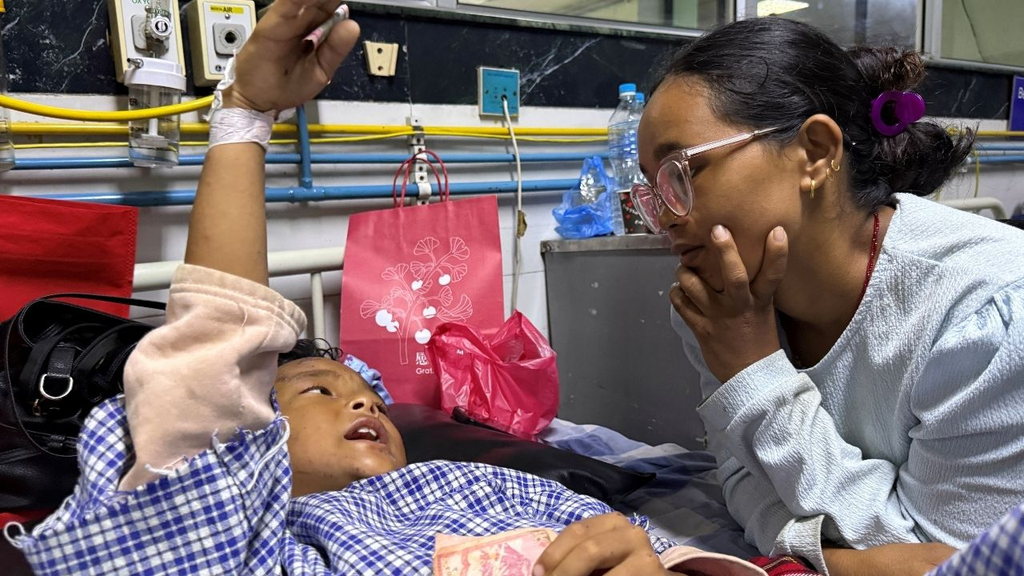
Zoyal ran into a nearby forest with a friend and climbed a tree to escape the rising water. He suffered a broken leg and cuts to his face in the process, but he held on until rescuers found him. He was airlifted out alone, unable to tell anyone who his family was. When rescuers reached him, he was clutching two ten-rupee notes that police officers had given him to persuade him to go with them to hospital.
Tamang, meanwhile, went from shelter to shelter and checked collection-point lists for her sons’ names. “At the fourth place too, my children’s names were not there,” she told Reuters. “I had come to accept that both my children were no more.” She found her younger son alive first. Zoyal remained missing for two more days, until a contact traced him to a small hospital in Kathmandu and the family was reunited on August 28.
Zoyal’s story is, in the end, a story about how little agency an eight-year-old has in a disaster of this scale — no warning system reached him, no adult was present to direct him — and how much still came down to instinct, a tree, and luck.
Not everyone was saved
Not every family in the Trishuli Valley has a reunion story to tell. Along the river, a dozen hydropower projects were under construction or in operation when the flood hit, and roughly 900 workers were reported missing at these sites in the days afterward, many of them believed trapped in tunnels buried by mud.
Bhakti Ram Bohara survived. He estimated that only around 100 of the roughly 1,000 workers at his project and nearby sites made it out. Among those still missing was his brother-in-law, who had worked alongside him on the same team, away from his family for weeks at a time to send money home. “His wife is my sister, and she is pregnant,” Bohara told CNN, before breaking down.
Another survivor, Ram Chandra, described gripping the rungs set into a tunnel ceiling to pull himself out through rushing water, concrete and debris as his colleagues tried to do the same behind him.
Weeks after the flood, some of those tunnels had still not been fully searched. Rescue teams from Nepal, India and China worked to bore into collapsed sections, uncertain how many workers might still be alive inside — reinforced tunnels can hold pockets of air for a time, but the odds narrow with each day. For families like Bohara’s, the disaster has not resolved into either grief or relief. It remains, for now, an open wait.
What these stories reveal
Set side by side, these four stories point to the same underlying truth: in a flood that reached some communities within minutes of its trigger, almost nothing about the outcome was decided by chance alone. It was decided by who received a warning, how quickly they acted on it, and whether there was somewhere higher to run.
Nepal did not have a formal early-warning system covering the upper Trishuli Valley that morning. What saved the students at Dawadi’s school was an informal chain — a colleague’s warning, a phone call, a worried parent — that happened to arrive in time, combined with a principal willing to act on an unconfirmed threat rather than wait for official confirmation. That is a fragile system to depend on. It worked once. It is not something any country should want to rely on again.
Hydrologists have noted that detecting and providing advance warning for a sudden glacier collapse, as opposed to a slower-building glacial lake outburst flood, is especially difficult — there may be no swelling lake to monitor, no gradual pressure to track, just a mountain that gives way. Nepal, Pakistan, Bhutan and India have all begun installing glacial-flood early-warning systems at some of the more than 200 glacial lakes now considered high-hazard across the Himalayan region, but funding and installation have lagged behind the identified risk for years. A well-documented lake in Sikkim, for instance, was slated for an early-warning system that had not been completed when it burst in 2023, killing dozens.
Schools sit at the center of this vulnerability, because they concentrate large numbers of children in a fixed location for hours at a time, often near rivers, with only the adults on site able to make an evacuation call in real time. Dawadi had no written evacuation protocol requiring him to act; he had instinct, local knowledge of the terrain, and the authority to ring a bell and be obeyed. Not every school administrator has all three.
Community response mattered as much as any system. Sonika’s mother could hand her son to a thirteen-year-old with confidence that she would run in the right direction. Zoyal’s rescue depended on strangers — police officers, hospital staff, a contact who worked the phones for his mother — none of whom were part of any formal disaster plan, but who filled the gaps one by one until a family was whole again.
On causes, scientists have been careful. The immediate trigger was a large piece of the Langtang Lirung glacier breaking away and falling into the valley, generating a seismic signal that some officials initially, and incorrectly, described as an earthquake. The United States Geological Survey later determined the tremor was produced by the collapse itself. Whether this specific event was primarily a glacier collapse and debris avalanche, or involved a glacial lake outburst flood as well, remains under study. What is not in dispute is the broader trend: the Hindu Kush Himalaya region is warming faster than the global average, permafrost that once held mountain slopes together is thawing, and glacial lakes across the region are growing. Researchers are careful to say that rising temperatures make disasters like this one more likely over time, without claiming that any single event was caused by climate change alone. Both things are true at once — this flood had a specific, physical trigger on one mountainside, and it occurred in a region where that kind of trigger is becoming statistically more probable.
Conclusion
Disasters of this scale can look, from a distance, like they are simply too large for individual choices to matter. The death toll in Nepal will likely rise into the low thousands once the missing are accounted for. And yet at Tribhuvan Trishuli Secondary School, the number of student deaths was zero — not because the flood spared that location, but because one man rang a bell before he was certain he needed to.
Nepal’s mountains have always produced sudden, violent floods; this is not a new hazard. What is changing is the frequency with which the underlying conditions — melting glaciers, growing glacial lakes, thawing permafrost — are being tested to their limits. Communities in the Himalayas will keep facing this risk, and so, increasingly, will communities well beyond Nepal, from the Andes to the Alps to the mountains of the Pacific Northwest, wherever glaciers are retreating and people live downstream.
Nepal’s flood is not only a Nepali story. It is a preview.
Five lessons for the world
- Early warnings must reach people directly, not just officially. The chain that saved Dawadi’s school — a colleague’s shout, a phone call, a worried parent at the gate — worked because multiple informal channels converged. Formal systems should be built to supplement that redundancy, not replace it: mobile alerts, village-level sirens, and designated community messengers matter as much as satellite monitoring.
- Schools need a standing evacuation plan that does not depend on one person’s judgment. Dawadi acted correctly and fast, but he had no protocol requiring him to. Schools in flood- and landslide-prone valleys need a designated official with pre-authorized power to halt classes and evacuate on an unconfirmed warning, plus a known route to higher ground rehearsed in advance.
- Local leaders — teachers, ward officials, health workers — need the authority to act on incomplete information. Waiting for confirmation from a district or national authority costs the minutes that, in this flood, were the entire margin between survival and death. Decision-making needs to be pushed down to the people closest to the danger.
- Glacial-lake and glacier-collapse monitoring needs sustained funding, not one-off pilot projects. Early-warning systems have been proposed for high-risk Himalayan lakes for years; several, including in India, were still incomplete when disaster struck. Identifying a hazard without funding the response to it protects no one.
- Preparedness has to be budgeted as a life-saving investment, not an afterthought after the next disaster. The infrastructure that failed in this flood — bridges, hydropower tunnels, unprotected river-adjacent settlements — was built without fully pricing in a hazard scientists have been describing for over a decade. Rebuilding it the same way guarantees the next flood costs the same lives.
Sources
- The Associated Press, “This principal in Nepal evacuated 900 students before flooding swept away their school,” August 31, 2026.
- NBC News, “Fast-acting principal in Nepal evacuated 900 students before flooding swept away their school,” August 31, 2026.
- UNICEF Nepal, “‘I didn’t know where my parents were’: A 13-year-old’s escape from the floods,” August 2026.
- Reuters (via U.S. News & World Report), “Mother Reunited With 8-Year-Old Who Climbed Trees to Survive Nepal Floods,” August 28, 2026.
- Al Jazeera, “8-year-old Nepal flood survivor reunited with mother after rescue,” August 28, 2026.
- CNN, “Race against time to find workers missing in Nepal’s hydropower tunnels. Here’s what we know,” August 31, 2026.
- CNN, “Mass burials take place as Nepal-China floods death toll tops 1,000,” August 31, 2026.
- UN News, “Nepal flooding deaths surpass 900 as needs climb,” August 31, 2026.
- CBS News, “Deadly Nepal flood highlights glacier risks in warming Himalayas: ‘The new normal,'” August 2026.
- CBC News, “Why scientists fear Nepal’s disaster is just a glimpse of the carnage climate change could cause,” August 2026.
- Wikipedia, “2026 Nepal floods” (aggregating USGS, Nepal’s National Disaster Risk Reduction and Management Authority, and Nepali/international press reporting), accessed September 2, 2026.
- The Business Standard, “1,643 children, one warning: How a Nepal principal pulled off a heroic rescue,” August 2026.