The border between Cambodia and Thailand has once again become the scene of armed confrontation. On December 7, 2025, gunfire erupted along the frontier near the Preah Vihear area, resulting in dozens of soldiers and civilians from both countries being killed, many others injured and more than half a million people displaced as clashes escalated. The renewed violence has also severely disrupted civilian life: at least 377 schools in four border provinces, including Oddar Meanchey, Banteay Meanchey, Preah Vihear and Battambang, were forced to close, affecting more than 78,585 students and 3,197 teachers as shooting continued across the frontier. This disruption came after Thai forces opened heavy and sustained fire into Cambodian territory, according to the Cambodian Ministry of Education, Youth and Sport. For families living along the border, the renewed violence has revived long-standing fears that peace in the region remains fragile.
Despite longstanding claims about map overlaps, this conflict is not merely a technical disagreement about territorial lines. What Cambodia faces today is a situation shaped by deliberate political and military decisions made in Thailand. Thai leaders and generals, speaking publicly and without restraint, have openly called for forceful action against Cambodia, positioning the country as a target for aggression rather than a partner for dialogue.
This shift is evident in statements from senior Thai military officials. General Chaiyapruek Duangpraphat declared that “Our objective is for the Army to render Cambodia’s military capability ineffective for a very long time, for the safety of our children and grandchildren” (The Nation Thailand). Likewise, the Thai 2nd Army Region issued a public statement asserting that “the 2nd Army Region retaliated against Cambodian military actions that posed a direct threat to Thailand’s security, as well as the safety of the civilian population residing in the border areas” (The Nation Thailand). Political leaders reinforced this posture. Thai Prime Minister Anutin Charnvirakul emphasized that “Thailand has never sought violence… but we will never tolerate a violation of our sovereignty,” framing the escalation as a security necessity rather than a diplomatic failure.
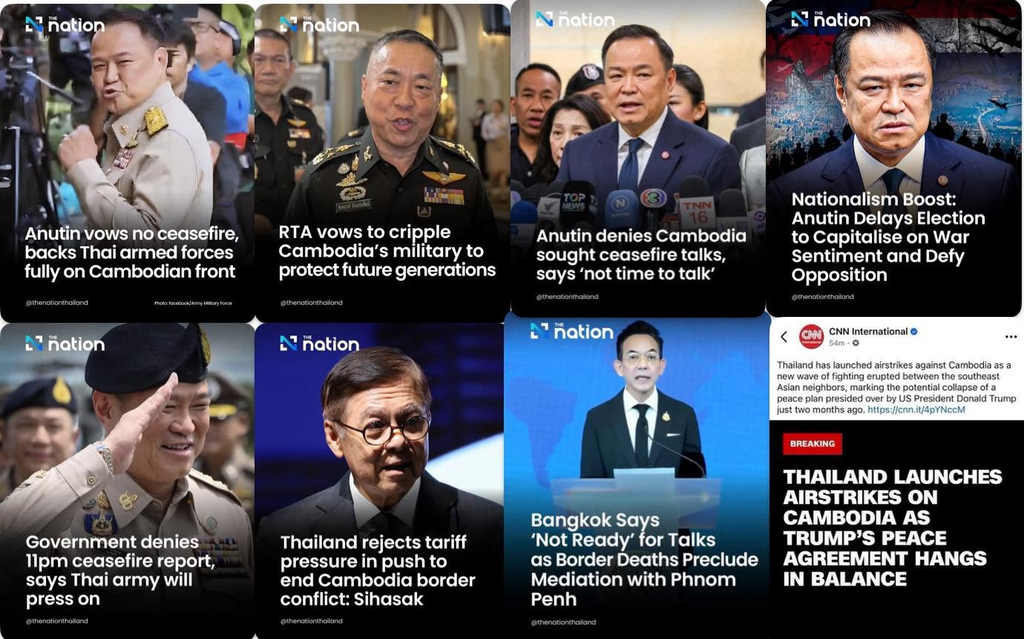
More troublingly, some voices within the Thai leadership have encouraged widening the tensions into provinces where no dispute has ever existed, effectively fabricating new zones of conflict. Such actions and rhetoric directly contradict the principles of international law, especially the obligation to resolve disputes peacefully and respect the sovereignty of states.
Under international humanitarian law, including Article 8 of the Rome Statute of the International Criminal Court, intentional attacks against civilians, willful killings, destruction of civilian property, and the forced displacement of populations constitute war crimes when carried out as part of a plan, policy, or large-scale operation. Any escalation that targets or harms non-combatants therefore risks falling under the ICC’s definition of war crimes.
The timing of these escalations raises serious concerns. As Thailand moves toward a general election, it is clear that political incentives are influencing military posture. Nationalist narratives offer powerful tools for rallying public support and some political actors appear willing to use border tensions to gain leverage. In doing so, they risk the lives of soldiers, disrupt diplomatic relations, and destabilize communities that have coexisted peacefully for generations.
Cultural and Civilian Devastation
As the conflict unfolded, the damage extended far beyond military targets. The cultural cost has been severe:
- Ta Krobei Temple was reportedly destroyed entirely.
- Preah Vihear Temple, a UNESCO World Heritage Site, sustained serious structural damage.
- Civilian homes, local administrative buildings, and schools were affected by artillery strikes.
- Border communities experienced an immediate economic shutdown as trade routes closed.
- Trauma, particularly among children, will have lasting consequences.
- Nationalist propaganda has contributed to rising racial discrimination, deepening divisions between Khmer and Thai citizens.
These cultural and human losses represent a profound setback. Temples that carry centuries of history, identity and cultural pride have become casualties of present-day political maneuvering.
Diplomatic Efforts and Persistent Deadlock
Regional and international actors have urged restraint as border violence intensifies. Malaysia’s prime minister called on both sides to de-escalate, warning that the conflict now poses a broader regional risk. U.S. President Donald Trump has also been described as ready to intervene diplomatically if conditions permit. Yet despite these signals, the fighting continues, and border communities remain caught in uncertainty.
Cambodia has expanded its diplomatic outreach, briefing foreign envoys and urging a renewed commitment to peace mechanisms. The United Nations has likewise called on both countries to return to established agreements and halt further escalation.
In this context, Cambodia has formally requested UN Security Council intervention to help contain the conflict.
These efforts underscore Cambodia’s continued reliance on multilateral diplomacy even as unilateral military pressure persists along the border.
A Call for Responsible Leadership
The ongoing confrontation reveals how political ambition can overshadow moral responsibility. Leaders who inflame border conflicts to secure political gains place their citizens at unacceptable risk and jeopardize regional stability. The consequences, lives lost, cultural heritage destroyed and communities divided, are far greater than any temporary political advantage.
We live in an era that demands dialogue, not destruction. Cambodia and Thailand share history, geography, and cultural threads that should bind rather than divide. Peace cannot be built on artillery fire, nor can stability emerge from manufactured hostility.
The region deserves leadership grounded in responsibility, dignity, and a commitment to negotiation. Politicians must abandon tactics that exploit nationalism and instead pursue solutions that protect the lives and futures of their people.
We have one region, one shared history and one world. The path forward must be shaped by dialogue and understanding—not violence.