It was twenty-five years ago when an actress, playing the role of Lara Croft, swung across the temples of Angkor Wat, and Cambodia would not leave her alone. Not long afterward, Angelina Jolie came back to Cambodia as a humanitarian, where, in 2002, she adopted a baby boy from an orphanage in Battambang province, who she called Maddox. In order to make sure he stays in the country of his origin, she bought a small house there a year later, on lands that were adjacent to the Cardamom Mountains, but infested by poachers then searching for wildlife that was disappearing. She turned that piece of land into a wildlife refuge, which later became the Maddox Jolie-Pitt Foundation that has been working in the area for more than two decades now.
This bond was further strengthened in 2017 when Jolie went back to Battambang and Siem Reap in order to direct and write her film titled “First They Killed My Father,” a Khmer language movie – filmed using an almost all Cambodian cast – depicting the story of the Khmer Rouge Genocide from the perspective of a child. According to her, it was the most personal film she has ever made, coming from a country which she now considers to be her permanent home, although only once her younger children become adults.
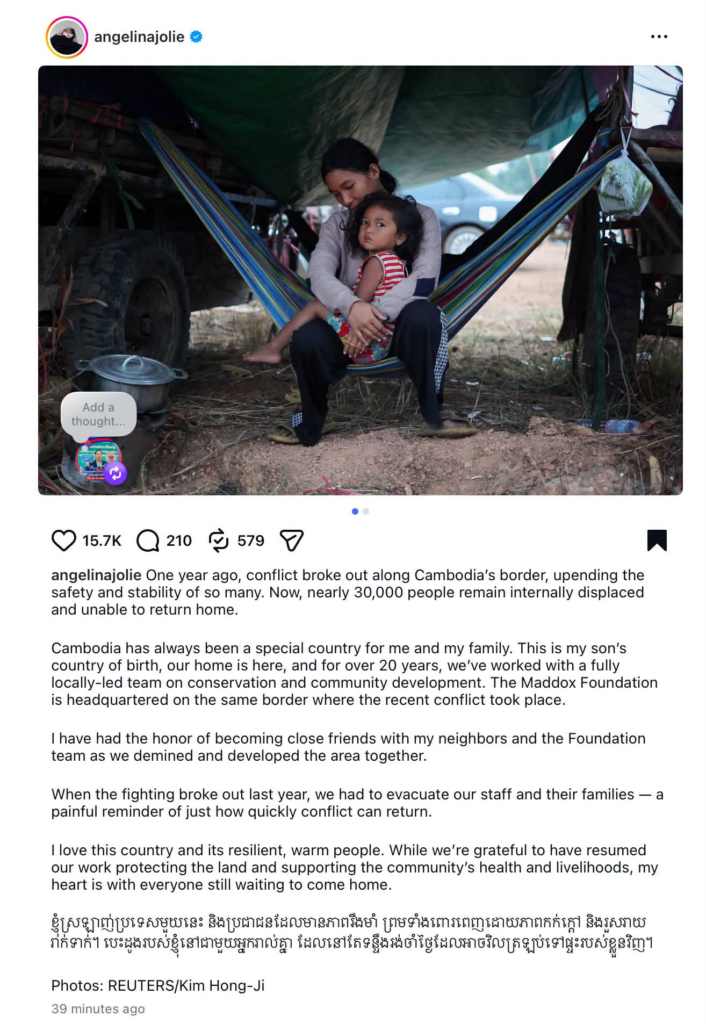
For this reason, Jolie’s use of Instagram to discuss what was happening in Cambodia a year after the fighting erupted between Cambodia and Thailand is neither a temporary nor superficial intervention by an international celebrity into a local conflict. Instead, it is a story told by a person referring to a place as the country of her child and increasingly, herself. She described how the fighting had destabilized many lives and left 30,000 people displaced from their homes. She explained how she had to move the staff and their family members of her foundation out of the way of fighting when the conflict reached the border of their headquarters. “My heart is with those who are waiting to return home,” Jolie wrote.
This was a very short note on the web. However, this note came at a time when the situation itself has already become hard to define – not because the crisis was resolved, but because the manner in which the conflict is accounted has begun to become blurred.
A Crisis Measured Three Different Ways
Within five days prior to Jolie’s post, three Cambodian officials provided three different displacement numbers to three different groups of listeners. Specifically, on July 20, Foreign Minister Prak Sokhonn reported more than 20,000 people needed aid for their return to their homes to other ASEAN foreign ministers and the bloc’s human rights commission. In turn, two days after that, Senate President Hun Sen stated that more than 3,000 families were yet to return to their places of residence to UN Special Rapporteur on Cambodia, Thomas Andrews. Finally, on July 24, the number cited in Jolie’s post without a named source and date was nearly 30,000 people.
The most recent official displacement count provided on a national level comes from the Ministry of Interior: 28,460 civilians were displaced, among whom there were 14,613 women and 9,592 children, out of 615,000 people who came back home, which constituted 95 percent of more than 640,000 uprooted civilians by the peak of the conflict in December 2025.
They are not just conflicting bureaucratic sounds. Humans, families, and camp dwellers cannot be equated to one another as units, for each carries a different meaning of the same open wound. A family of eight people is the same as a family of two, but in different counts. In taking away from the figure that reaches the outside world its origin and the date that it was counted, as was done with the figure cited in Jolie’s post, the public is deprived of asking the most fundamental question posed by a humanitarian crisis: Who exactly suffers anymore, and how do we know?
Life Behind the Number
Some of what is obscured by the overall numbers can be found at one displacement camp. In the Takoeng Temporary War Refugee Center, located in Preah Vihear province, the government has constructed 682 homes for 645 households totaling 2,061 individuals who hail from four villages that have been identified by the government as “red zones” — places where it is not safe to return. Each household is granted $25 per month, with an additional $7 per additional family member, whether the household is made up of two individuals or eight.
The reason for this separation from home, according to provincial officials, is practical. According to Deputy Provincial Governor Min Sitha, their land is inaccessible, surrounded by razor wire and shipping containers. As the Cambodian government explains, there were either inhabited or destroyed homes in the region during the fighting, while unexploded ordnance litters other parts of the area. The June ministry report noted the damage caused to the basic facilities in the border provinces, including the closure of eight schools and five health facilities in Oddar Meanchey, five schools and one health facility in Banteay Meanchey, seven schools and two health facilities in Preah Vihear. To thousands of children, the anniversary of the conflict represents not news but a second year without any functional classrooms.
The version of events by Thailand is completely different. As reported on March 31, by Maj. Gen. Winthai Suvaree, spokesman for the Royal Thai Army, Cambodia’s claim that the Thai troops were preventing up to 100,000 people from coming back was greatly exaggerated, and only thousands of residents were affected in the villages, which according to Thailand, belonged to it.
An Unresolved Question of Territory — and of Rights
Beneath the dueling personalities is an unresolved legal issue. On January 3, 2025, the Cambodian permanent representative, in a letter to the UN Secretary-General, stated that in the period of Thai military activities from December 7 to 27, Thai troops effectively controlled areas located in the Cambodian territories in four provinces, including some areas of Preah Vihear, and in doing so were denying displaced Cambodian civilians access to their homelands. The permanent representative of Thailand replied on January 19, saying that the maintenance of troop positions after the ceasefire agreement is compatible with the de-escalation of the situation, which was stated by both parties in the joint declaration made on December 27. The body responsible for marking the border officially is the Joint Boundary Commission, but this body stopped its activity until the elections in Thailand in February.
Until the boundary line is established, the return of thousands of civilians back to their own homes becomes hostage to a diplomatic and legal process which neither party alone controls. This is the essence of the justice issue that comes to light from the anniversary. The people stranded in this situation – 2,061 civilians of Takoeng, the thousands of children unable to go to schools, the families of 25 dollars a month living someplace other than their homes – were not the ones to place the two armies in their positions nor to decide the speed of the boundary commission.
The UN special rapporteur Thomas Andrews has begun his twelve day mission to Cambodia on July 20th with the visit to Banteay Meanchey and Siem Reap and a report in October. This report provides one of the few chances in the immediate future to have an independent, up-to-date account of who among the civilians is still displaced and why – the kind of information that neither the fluctuating government statistics nor an Instagram post by a celebrity can provide.
What This Anniversary Should Ask For
The message that Angelina Jolie delivered was one that only someone who has lived with the problem for twenty years could deliver: it humanized a crisis that seemed ready to be forgotten in the midst of changing media focus. The evacuation of her foundation, in the very place where the conflict began, is a small yet significant piece of information, reminding us that this conflict is not only about strangers whose numbers keep rising but also people whom she knows and has known for many years. However, bringing attention to the problem will not help bring justice to those living in camps; it needs:
- A single, transparently dated national count of displacement — one that distinguishes people, families, and households — so that Cambodian and international actors are working from the same picture.
- Independent verification of competing Cambodian and Thai claims about access, occupation, and unexploded ordnance in the affected villages, ideally informed by the Special Rapporteur’s October findings.
- Accelerated demarcation work by the Joint Boundary Commission, since the legal status of the border is now directly determining whether civilians can go home.
- Continued humanitarian support — shelter, stipends, and above all restored schools and health facilities — that does not lapse simply because the conflict itself is a year old and no longer new news.
A year later, the violence is over, but for almost 30,000 people, the fight is not over; it is just taking a new form, from being displaced by shelling to being displaced by the unyielding diplomacy. It will not be quantified through engagement on Instagram or statements from ministers to different audiences using different figures. Instead, it will be quantified by how long the families of Takoeng, and other villages like theirs, continue to live in temporary shelters during their second, third, or fourth anniversary — or if they finally get to have a place to call home, like the place where Angelina Jolie has spent half her life going back to.
Sources
- Ponley Reth, “A year after the border conflict, Cambodia’s displaced are counted as people, as families and as camp residents,” Midnight, 26 July 2026.
- “Foreign Minister urges ASEAN counterparts to support return of displaced civilians,” Phnom Penh Post, 20 July 2026.
- “UN Special Rapporteur outlines planned visit to displacement camps,” Phnom Penh Post, 22 July 2026.
- “Angelina Jolie renews global attention on Cambodia’s border displacement crisis,” Phnom Penh Post, 24 July 2026.
- “Despite ceasefire, home still out of reach for more than 28k Cambodians,” Phnom Penh Post, 15 June 2026.
- “A year after war, new homes cannot replace those left behind,” Phnom Penh Post, 23 July 2026.
- Permanent Mission of Cambodia to the UN, letter to the Secretary-General, A/80/587, 3 January 2026.
- Permanent Mission of Thailand to the UN, letter to the Secretary-General, A/80/593, 19 January 2026.
- “Army denies blocking return of displaced,” Bangkok Post, March 2026.
- “UN rights rapporteur Tom Andrews to visit Cambodia, meet border conflict victims,” Cambodianess, July 2026.
- “Angelina Jolie Pitt to Direct Netflix Drama Set in Cambodia,” The Hollywood Reporter, 24 July 2015.
- Angelina Jolie, Wikipedia entry — background on the Maddox Jolie-Pitt Foundation and the Battambang land purchase.
Additional coverage of Angelina Jolie’s Instagram post (24 July 2026)
- “Angelina Jolie says 30,000 remain displaced after Cambodia border conflict,” Khaosod English.
- “Angelina Jolie renews global attention on Cambodia’s border displacement crisis,” The Star.
- “Angelina Jolie backs Cambodia border dispute resolution,” Khmer Times.
- “Angelina Jolie says her heart remains with Cambodians displaced by border conflict,” Khmer Times.
- “Angelina Jolie recalls hardship of Cambodians displaced by border conflict,” Cambodianess.
- “Angelina Jolie shares emotional update on family ‘home’ in Cambodia after vowing to leave U.S.,” People/Yahoo Entertainment.