🇰🇭 🇲🇲

President U Min Aung Hlaing of Myanmar’s two-day state visit to Cambodia that took place on 11-12 September 2026 was not only a milestone in the diplomatic relations between the two Southeast Asian states but was also significant in terms of its political impact within the region of ASEAN as well as at the international level regarding the political crisis in Myanmar.
First of all, the visit took place at the official invitation of King Norodom Sihamoni, while for Myanmar it was a very challenging period due to the political instability, civil wars, humanitarian problems, and diplomatic isolation after the military coup of February 2021. In these circumstances, the Cambodian decision to receive Min Aung Hlaing as a head of state was highly symbolic.
Strengthening Cambodia–Myanmar Bilateral Relations
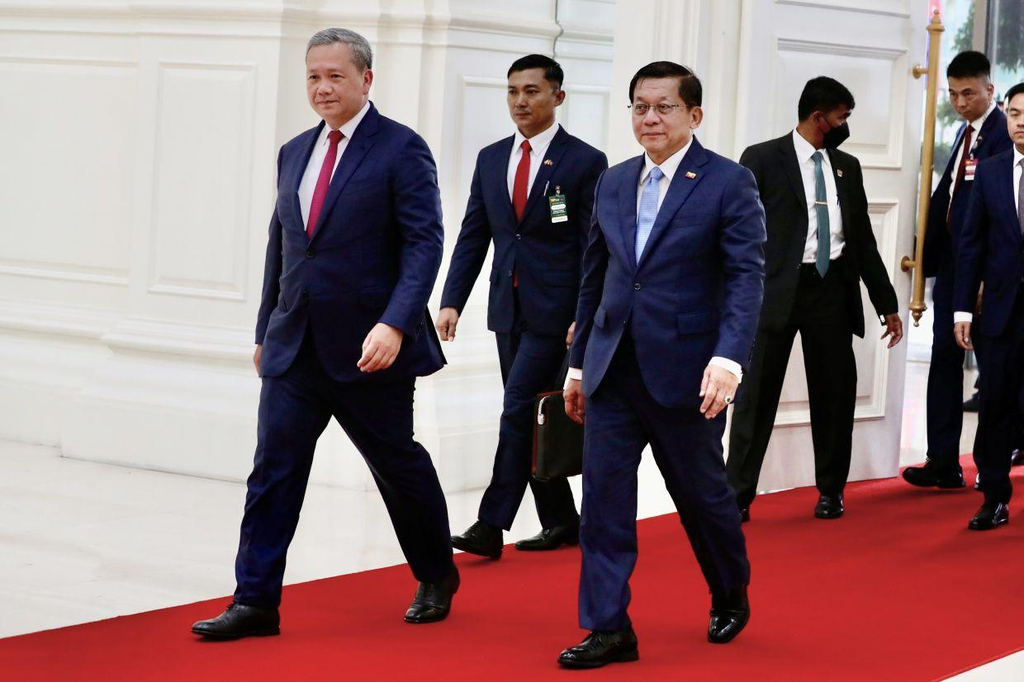
Min Aung Hlaing took part in a summit with the President of the Senate and Acting Head of State, Hun Sen, and bilateral talks with Prime Minister Hun Manet. Additionally, he held a meeting with National Assembly President Khuon Sudary.
The talks were dedicated to the development of established bilateral relations, the development of economic cooperation, and exchange of opinions on regional and international issues. Both parties agreed that they have to keep up friendly relations that started when diplomatic relations were established on 12 July 1955.
One of the key achievements of the visit was the signing of four cooperation agreements. They concern such issues as the elimination of double taxation and prevention of tax evasion, reciprocal investment promotion and protection, amendments to the cultural cooperation agreement, and media and information cooperation.
Thus, one can see that the two governments are ready to engage not only in traditional political and diplomatic but also in other spheres of cooperation, such as economic, cultural, and informational.
However, it is the actual implementation of the signed agreements that will show how beneficial the visit will be for both Cambodia and Myanmar.
Cambodia’s Diplomatic Position on Myanmar
It is also necessary to consider Cambodia’s interaction with Myanmar within the framework of its foreign policy strategy and involvement in ASEAN diplomatic relations.
Cambodia has already been active in participating in the attempts to resolve the situation with Myanmar. In January 2022, Hun Sen, the Prime Minister of Cambodia and the chair of ASEAN at that time, made a visit to Myanmar, where he met Min Aung Hlaing. This visit was the first attempt to foster diplomatic dialogue and progress in the ASEAN Five-Point Consensus.
Thus, the visit to Myanmar in September 2026 may be considered another example of diplomatic engagement of Cambodia with the political regime of Myanmar.
From the perspective of Cambodia, maintaining bilateral diplomatic relations may be seen as an opportunity for fostering cooperation and maintaining regional relations through diplomatic channels. At the same time, diplomatic relations do not mean political endorsement.
This issue becomes especially relevant with regard to the ongoing conflict and humanitarian situation in Myanmar. Cambodia needs to find the balance between its sovereign rights to maintain diplomatic relations and its obligations as an ASEAN member.
ASEAN Unity and the Five-Point Consensus
Possibly one of the most important aspects is its implications for ASEAN.
After the military coup of 2021, ASEAN established the Five-Point Consensus, which called for an immediate halt to violence, constructive dialogue between all parties involved, mediation through the ASEAN special envoy, humanitarian assistance, and an opportunity for the special envoy to meet stakeholders.
Unfortunately, its implementation has been insufficient. Additionally, the military junta of Myanmar has not participated in high-level ASEAN meetings due to insufficient progress on the Five-Point Consensus.
Diplomatic initiatives made by Min Aung Hlaing towards several ASEAN member states, namely Cambodia, Laos, Thailand, Vietnam, and Malaysia, are increasingly revealing disagreements between regional governments on the issue of dealing with Myanmar.
In accordance with Reuters news on 13 November 2026, there is pressure once again on ASEAN countries to reconsider the restrictions on Myanmar’s involvement in high-level discussions. Some states prefer more engagement, while others think that too early political engagement might jeopardize their united stance.
Taking into account the situation in the region, one should analyze the engagement of Cambodia. Even though bilateral diplomacy might help keep lines of communication open and provide an opportunity for cooperation, inconsistent behavior by ASEAN members will make the Five-Point Consensus irrelevant.
Diplomatic Engagement versus Political Legitimacy
However, the visit was criticized by Myanmar’s opposition groups and human rights organizations as well. The reason was that allowing Min Aung Hlaing to visit Cambodia as a formal visit of the head of state can give him political recognition.
According to Associated Press, Khmer Movement for Democracy, which is an opposition movement created by political elites in exile, stated that the visit was made to circumvent diplomatic constraints imposed by ASEAN. Human rights organization Fortify Rights urged Cambodia to reconsider this visit as well.
This situation shows a bigger dilemma in international relations, which is whether it is possible to separate diplomatic ties from political recognition.
Diplomatic dialogue often takes place between states and governments whose political legitimacy is under question. Engagement may be important for practical reasons such as conflict prevention, humanitarian aid, economic cooperation and regional stability among others. However, the way and the extent of the diplomatic engagement may have its implications as well.
For Cambodia the issue is not to allow engagement of bilateral relations to undermine its commitment to peaceful conflict resolution and humanitarian principles as well as the regional framework agreed by ASEAN.
The Way Forward: Balancing Bilateral Interests and Regional Responsibility
There exists a potential for further strengthening and developing the relationships between Cambodia and Myanmar through trade, investments, cultural exchanges, education, and other people-to-people cooperation. Yet, one should not underestimate the long-term significance of the September visit only in terms of number of agreements concluded and diplomatic meetings held.
Above all else, the Cambodian government should take advantage of diplomatic relationships with Myanmar to foster positive changes associated with peace-making, inclusive political dialogue, humanitarian aid, and regional cooperation.
In terms of ASEAN diplomacy, one should realize the necessity for a unified approach in regard to Myanmar that takes into account both the importance of diplomatic relations and regional commitments made.
Thus, bilateral relations should not contradict collective work aimed at addressing the Myanmar crisis situation.
In general, the visit of the president of Myanmar to Cambodia can be regarded as evidence of a complicated relationship between national interests and responsibilities in regional context in ASEAN diplomacy.
One should understand that diplomacy remains an important tool for foreign policy, but its efficiency lies in contribution to peace, stability and political changes in the region.