🇰🇭 🇫🇷 🇹🇭

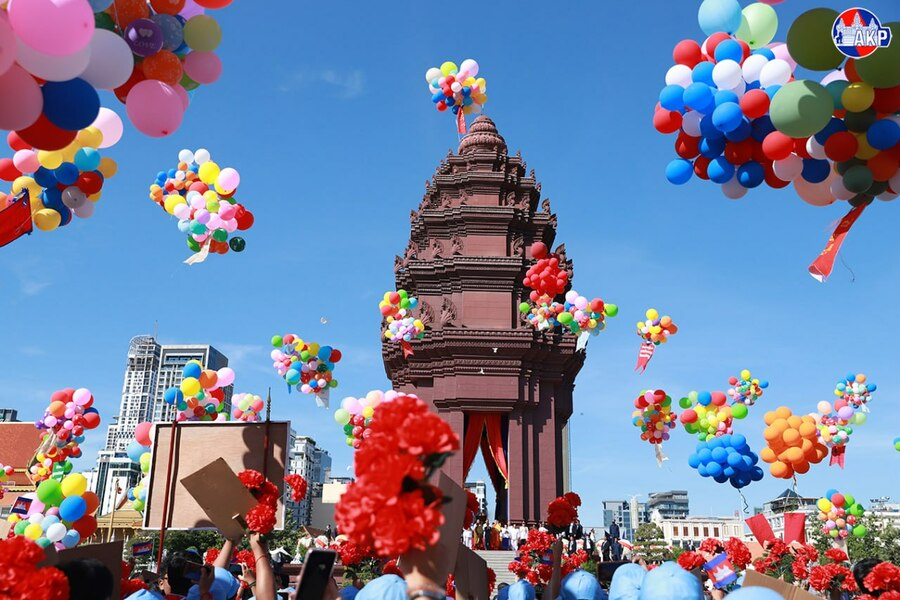
On November 9, 2026, Cambodia celebrated the 73rd anniversary of the country’s independence from colonial rule by the French. The Independence Day is an important milestone in Cambodia’s political development as it marks the success of the Royal Crusade for Independence organized by the former king of Cambodia, Norodom Sihanouk, that was held in 1953.
Nonetheless, the Independence Day in Cambodia goes beyond the fact of independence from colonial powers. It allows one to consider the historical background of Cambodia’s territorial integrity, the contribution made by France in the process of defining the borders of the country, and the importance of historical maps and international law in resolving the Cambodia-Thailand border issue.
Seventy-three years have passed since the independence of Cambodia but its colonial past is still relevant nowadays.
From French Protectorate to an Independent Cambodia
In 1863, Cambodia became a French protectorate, which meant that there was French colonial intervention in the political and administrative affairs of Cambodia, as well as control over the foreign policy of the country. Although the Cambodian monarchy was preserved, some essential parts of governance and territorial administration were controlled by the French.
The struggle for independence took place during the reign of King Norodom Sihanouk, who worked on diplomatic talks and efforts on an international level, which led to obtaining independence for his country. Using the Royal Crusade for Independence, Sihanouk managed to persuade France to give its sovereignty to Cambodia.
The independence day in Cambodia was marked on 9 November 1953.
By becoming independent, Cambodia received the right to exercise its sovereignty concerning both domestic and international affairs and the right to protect the territorial integrity of the country and create its own foreign policy.
However, the end of the colonial period did not mean that the issue of territories, created as a result of negotiations between France and Siam, was not present in the relations between the two countries anymore.
France’s Historical Role in Defining Cambodia’s Borders
One interesting aspect of the legacy of the French protectorate in Cambodia is related to the historical documentation and mapping of Cambodia’s international boundaries.
As noted earlier, during the colonial period, France entered into territorial agreements with Siam through the Franco-Siamese Convention of 1904 and Treaty of 1907. These agreements helped lay down some important principles for determining the boundary between the two countries.
Moreover, the treaties resulted in the mapping and documentation of the boundary, including the famous Annex I map of the Preah Vihear region.
The maps assumed a great deal of importance because of the fact that the boundary had been mapped in such a way that it showed that the Preah Vihear temple fell within Cambodia’s territory.
Though the legality and interpretation of some maps have been disputed by both Cambodia and Thailand, their historical significance can certainly not be ignored because these documents later became important for Cambodia’s territorial claims.
Thus, one must understand that France’s role in shaping Cambodia’s territory has not been limited to being a colonial power in the country but also included their active participation in the processes of mapping and documentation of the international boundaries of the nation.
Historical Maps and the Legal Foundations of Cambodia’s Territorial Claims
The importance of such historical maps in relation to sovereignty became apparent in the dispute between Cambodia and Thailand over Preah Vihear Temple.
In 1954, after gaining independence, the Thai army entered and occupied the territory of the temple. In 1959, Cambodia turned the dispute into the Court of the International Court of Justice (ICJ).
The decision of the ICJ was made in 1962 and it stated that Preah Vihear Temple was located in territory of sovereign Cambodia. The decision of the ICJ was based mainly on the 1904 Franco-Siamese Treaty, the Annex I map, and the conduct of Siam and Thailand after that, including the map acceptance by Siam and Thailand.
Further, in 2013, ICJ clarified its previous decision by stating that all territory of the promontory of Preah Vihear belonged to the sovereignty of Cambodia.
Such decisions showed that historical treaties, maps, and conduct of the states could have the decisive importance in territorial disputes settlement under the international law.
It should be noted that the legal importance of such historical documents appeared not only because the maps were made by France but because of the applicability of the agreements and subsequent state conduct.
France’s Continuing Role in the Cambodia–Thailand Border Dispute
Historically, the relations between Cambodia and France have acquired a new diplomatic relevance due to the ongoing border dispute between Cambodia and Thailand.
In February 2026, the Prime Minister of Cambodia, Hun Manet, invited the President of France, Emmanuel Macron, to provide historical and technical documentation that might contribute to the resolution of the border issue. Moreover, Cambodia was interested in the assistance of France in terms of the historical record of the boundary.
In particular, the role of France is relevant to consider due to the historical role of France in terms of the surveying and mapping of the Cambodia-Siam border during the first decades of the twentieth century.
Historical documents, cartographic documents, technical records, and French expertise could contribute to the understanding of the context of the establishment of certain borders.
Such assistance could enhance the efforts of Cambodia to prove historically its positions at the negotiation table and other international legal forums, where the matter is supposed to be discussed.
It is, however, necessary to separate historical support from legal determination. The function of France today should be seen as offering the means for acquiring historical information rather than determining sovereignty on disputed territories independently.
In conclusion, the delineation of international borders should be based on treaties and other instruments that govern the process.
Independence and the Responsibility to Defend Sovereignty
Independence Day of Cambodia also serves another political purpose. It is not just about remembering when independence was gained by Cambodia but also about taking care of it.
Sovereignty, which was restored in 1953 and made Cambodia an independent country with rights and responsibilities to secure its territorial integrity, needs to be protected in today’s conditions with the help of proper institutions, diplomacy, legal tools, and adherence to international law.
The example of the border conflict between Cambodia and Thailand proves that the consequences of colonization are still alive in the modern regional politics.
This means that Cambodia should preserve its historical sources, develop its legal and diplomatic potential, and collaborate with other international actors. At the same time, it is clear that both Cambodia and Thailand need to solve their problems peacefully without any escalation of conflict and adhering to the existing diplomatic and legal mechanisms.
The experience of Preah Vihear shows how international law and international judicial bodies can help to deal with the territorial issues in a peaceful manner.
Conclusion: Independence as an Ongoing Commitment to Sovereignty
Despite the passage of seventy-three years since the sovereignty was fully returned by France to Cambodia, there are still some traces of colonial times in the modern foreign policy and territorial policy of the country.
The history of relationship with France plays an especially vital role for Cambodia due to the fact that the treaties, maps, and information about borders which were created during the colonial period still serve as important references when talking about Cambodian borders.
This can also be seen from the 1962 and 2013 ICJ decisions where Cambodia used historical facts and international laws in order to protect its territorial rights.
Thus, while marking the Independence Day in Cambodia, not only should 9 November be regarded as a date of national importance, but this day should make Cambodians think about the necessity of safeguarding their sovereignty and historical evidence, strengthening international legal capacity and friendly relations with neighbouring states.
It is not enough just to achieve the independence; in order to preserve it one should do the same efforts.
This is the main message that should be drawn for Cambodia regarding independence.
Key references for the article
- Cambodia Celebrates 73 Years of Independence Day from France — Agence Kampuchea Presse, 9 November 2026.
- Cambodia asks France to provide historical evidence to help settle Thai border dispute — Reuters, 5 February 2026.
- Thailand and Cambodia: The Battle for Preah Vihear — Stanford University.
- Why the Preah Vihear dispute between Cambodia and Thailand persists: An international law analysis — University of Navarra.
- ISEAS Perspective: Origins and Legalities of Border Disputes — ISEAS–Yusof Ishak Institute.