🇰🇭 🇫🇷 🇮🇩 🇺🇳

“Thirty-five years later, are the promises made in Paris still protecting Cambodia’s sovereignty?”
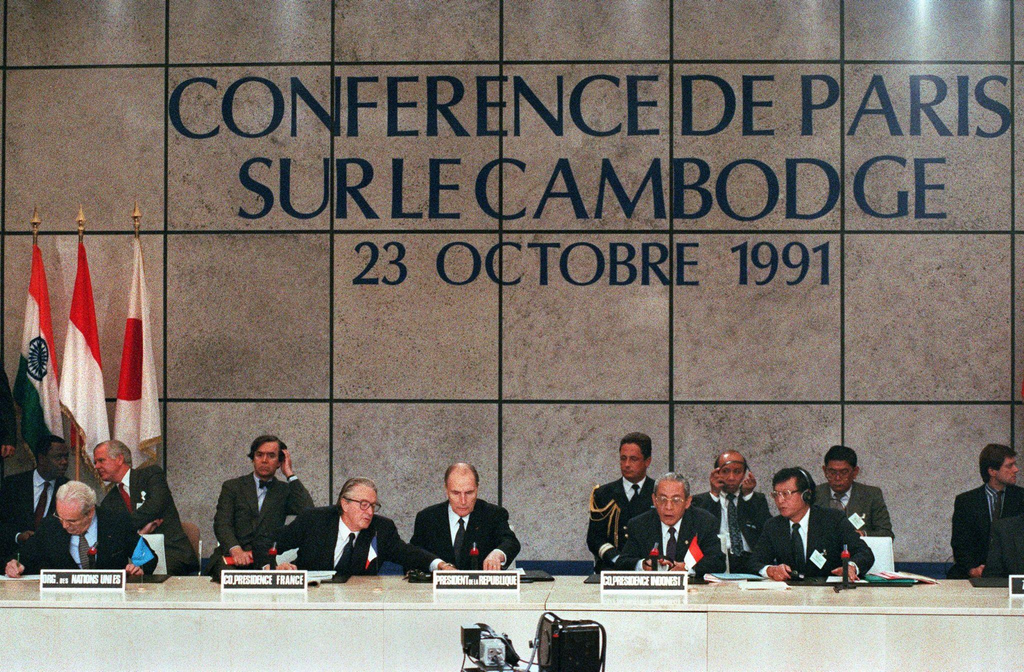
Cambodia made history on October 23, 1991, when representatives of the four Cambodian political factions and 18 participating governments signed the Paris Peace Agreements (PPAs) in Paris, France, in the presence of the UN Secretary-General. The Agreements provided an international framework for Cambodia’s democratic transition, reconciliation, and reconstruction after decades of violence.
The Agreements are now essential to Cambodia’s political and legal issues 35 years later. The Cambodia–Thailand border dispute has raised questions about whether Paris’ international commitments remain relevant and whether Cambodia should ask the UN and original signatories to reaffirm their sovereignty and territorial integrity.
This discussion centers on a key question: Have the 1991 international guaranties to Cambodia completed their historical function, or should they continue to influence international interaction with Cambodia?
Many Cambodian researchers, civil society organizations, and supporters still consider the Paris Peace Agreements important. They say Cambodia should aggressively engage the UN, France, Indonesia, and the other original signatories to reassert its sovereignty, independence, and territorial integrity.
The Historical Significance of the Paris Peace Agreements
Negotiations between Cambodia’s political groups, regional powers, and key international actors led to the Paris Peace Agreements. On October 23, 1991, they pledged to stop the Cambodian war and achieve political stability.
The Agreements included the Comprehensive Political Settlement of the Cambodia Conflict, the Agreement on Cambodia’s Sovereignty, Independence, Territorial Integrity and Inviolability, Neutrality, and National Unity, the Paris Conference Final Act, and the Declaration on Cambodia’s Rehabilitation and Reconstruction.
The comprehensive political solution gave the UN an unprecedented involvement through the UN Transitional Authority in Cambodia. It oversaw the truce, elections, refugee repatriation, and Cambodia’s political transition.
Importantly, the Agreements created international sovereignty and territorial integrity commitments for Cambodia.
The Comprehensive Political Settlement Agreement, as declared in Article 18:
“The other Signatories undertake to recognize and respect the sovereignty, independence, territorial integrity and inviolability, neutrality and national unity of Cambodia.”
Article 2 of the separate Agreement on Cambodia’s Sovereignty, Independence, Territorial Integrity and Inviolability, Neutrality, and National Unity committed the other parties to preserve these values.
These measures went beyond diplomatic goodwill. They were part of an international settlement to defend Cambodia’s independence and build peace.
The International Commitments Remain Relevant
Cambodian scholars and civil society leaders argue that the Paris Peace Agreements are more than historical texts. Instead, their international responsibilities apply, especially to Cambodia’s sovereignty and territorial integrity.
A crucial legal foundation is the Cambodian Sovereignty, Independence, Territorial Integrity and Inviolability, Neutrality, and National Unity Agreement.
The second article states:
“The other parties to this Agreement hereby solemnly undertake to recognize and to respect in every way the sovereignty, independence, territorial integrity and inviolability, neutrality and national unity of Cambodia.”
The article also emphasizes not interfering in Cambodia’s internal affairs, not threatening or using force against its territorial integrity, and resolving disagreements peacefully.
Article 4 also requires foreign nations to respect Cambodia’s sovereignty and territory.
These clauses help determine the original signatories’ ongoing duties. Their significance is especially relevant given current worries regarding Cambodia’s territorial integrity and peaceful regional ties.
The Cambodia–Thailand border tensions have refocused attention on this situation. Cambodian civil society organizations petitioned signatory nations to coordinate their support for Cambodia’s sovereignty and territorial integrity on August 29, 2025.
The petition cited Article 2 of the separate sovereignty accord and asked the international community to address Cambodia’s sovereignty and peace transgressions.
The organizations asked signatory governments to hold Article 5 talks, organize an impartial international fact-finding mission, and promote peaceful diplomatic methods.
These demands reflect a larger sense that international agreements should not lose their relevance just because political conditions have altered.
Despite their importance, the Agreements need careful legal interpretation. These arrangements, including UNTAC’s interim position, were meant to end following Cambodia’s democratic transition. Their completion does not always expire all international guaranties and commitments.
The United Nations and the Responsibility of the Original Signatories
The UN led Paris Peace Agreement negotiations and execution. Security Council Resolution 718, enacted on 31 October 1991, welcomed the Agreements and stated:
“Expresses its full support for the agreements for a comprehensive political settlement of the Cambodia conflict, signed in Paris on 23 October 1991.”
This historical participation provides the UN a prominent role in Agreement legacy talks.
For increased international participation, Cambodia should formally propose that the UN assess the relevance of international commitments and enable communication among original signatories.
The original signatures matter too. Australia, Brunei, Cambodia, Canada, China, France, India, Indonesia, Japan, Laos, Malaysia, the Philippines, Singapore, Thailand, the USSR, UK, US, Vietnam, and Yugoslavia participated.
This procedure is historically significant for France and Indonesia, Paris Conference co-chairs.
They might promote Cambodia’s sovereignty and territorial integrity and explore the Agreements’ significance diplomatically.
UNTAC’s reconstitution or the creation of a new international administration are not necessary for fresh involvement. Any suggested system must comply with the Agreements, UN Charter, and current international realities.
However, diplomatic engagements might reinforce Cambodia’s sovereignty, territorial integrity, peaceful conflict settlement, and regional stability.
The Cambodia–Thailand Border Dispute and the Relevance of the Paris Framework
The Paris Peace Agreements are crucial to regional security debates due to the Cambodia–Thailand border conflict.
Border tensions have highlighted questions regarding territorial integrity, force, civilian protection, and peaceful conflict resolution. These concerns strongly connect to 1991 Agreement principles.
Article 2 of Cambodia’s sovereignty Agreement demands signatories to avoid threats or use of force against Cambodia’s territorial integrity and resolve disputes peacefully.
This provision underpins Cambodia’s international diplomacy.
The Paris Peace Agreements do not automatically locate every contested border region. Bilateral agreements, historical facts, international law, and judicial or diplomatic institutions must resolve territorial delimitation and sovereignty conflicts.
The Paris framework’s international obligations to Cambodia’s sovereignty, territorial integrity, and peace make it valuable.
Thus, activating the Agreements might enhance border-resolution processes.
Beyond Commemoration: Reaffirming the International Guarantees
Cambodia should focus on actual diplomatic engagement rather than historical remembrance on the 35th anniversary of the Paris Peace Agreements.
There are various options.
First, Cambodia should conduct a thorough legal examination of the Agreements to identify elements that continue to impose international duties and explain implementation methods.
Second, the government might engage with France and Indonesia, the original conference co-chairs, on the international guaranties’ significance.
Third, Cambodia might officially request reaffirmation of its sovereignty, independence, and territorial integrity from the UN and original signatories.
Finally, Cambodia should continue to use peaceful and legal means to resolve its border disputes with Thailand, develop regional cooperation, and safeguard people.
This would show that Cambodia considers the Paris Peace Agreements as a significant diplomatic and legal legacy, not just a historical triumph.
Conclusion: Keeping the Spirit and Commitments of Paris Alive
Cambodia’s Paris Peace Agreements remain one of its greatest foreign diplomatic accomplishments 35 years later.
They ended decades of violence, helped Cambodia’s political transition, formed an unprecedented UN operation, and made international pledges to Cambodia’s sovereignty, independence, territorial integrity, neutrality, and national unity.
The Cambodia–Thailand border conflict has raised doubts regarding these international obligations and the original signatories’ duties.
Cambodian scholars and civil society advocates should remember the Agreements beyond history. Legal review, political engagement, and constructive cooperation with the UN and original signatories are needed to revive their international guaranties.
Cambodia must remember what was agreed in Paris on 23 October 1991 and guarantee that the Agreements’ principles and duties remain relevant in international relations.
Paris Peace Agreements are more than a war resolution. They represent worldwide support for Cambodia’s sovereignty, independence, territorial integrity, and peace.
The spirit of Paris should remain alive—not merely as a memory of Cambodia’s past, but as a continuing commitment to its peaceful and sovereign future.
Key evidence-based sources
- Agreement concerning the Sovereignty, Independence, Territorial Integrity and Inviolability, Neutrality and National Unity of Cambodia — United Nations Treaty Series.
- Agreement on a Comprehensive Political Settlement of the Cambodia Conflict — UN Treaty Collection.
- Petition to the Signatories of the Paris Peace Agreements — Cambodian civil society organisations, 29 August 2025.
- Cambodian Civil Society to Petition Paris Peace Agreements’ Signatories — Cambodian Institute for Democracy, August 2025.
- France Reaffirms Commitment to Paris Peace Agreements 35 Years After Signing — AKP, 23 October 2026.
- Cambodia: The Lessons and Legacy of UNTAC — Stockholm International Peace Research Institute.