As the world continues to grapple with armed conflicts, political polarization, forced displacement, climate insecurity, and the rapid spread of misinformation, peace has become one of the defining challenges of our time. From international conflicts to local violence, the repercussions of discord persist, jeopardizing both human security and sustainable development. Although governments and international organizations play key roles in peace processes, enduring peace requires more than just diplomatic agreements. It requires the active participation of individuals, communities, and especially young people.
In fact, young people make up almost half of the population and possess the creativity to propose solutions to various societal issues. However, youth’s role in peace is frequently undervalued, as they are often viewed as passive beneficiaries rather than active contributors. This is where a huge potential of youth to make a change remains unexplored.
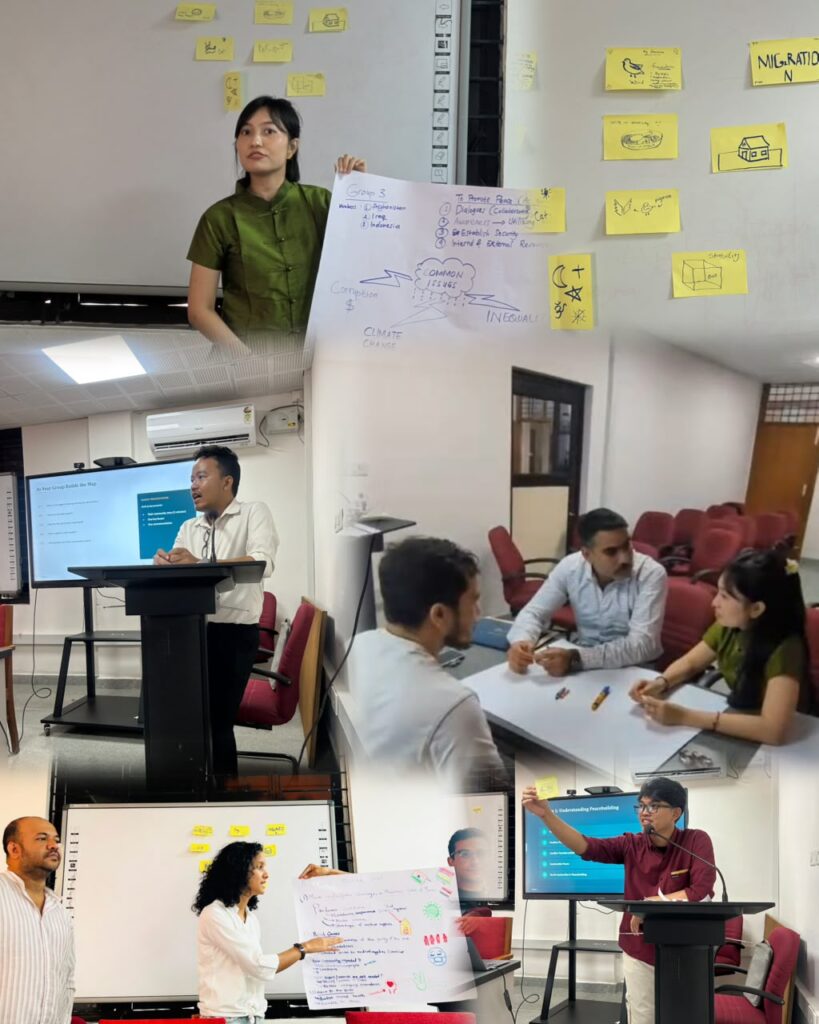
To translate these ideas into practice, the “Young Scholars for Peace: Building Collective Youth Leadership for Peacebuilding” workshop was organized by In Sokhuon with support from the White Dot Solidarity Network (WSN), in collaboration with the University Centre for International Co-operation (UCIC) and Mahatma Gandhi University International Student Association (MISA). Held at Mahatma Gandhi University, Kerala, India, the programme brought together 14 participants from Afghanistan, Cambodia, India, Indonesia, Iran, Iraq, Mauritius, Nigeria and Yemen. The workshop created a platform for intercultural dialogue, critical reflection, and collaborative learning. Participants explored peacebuilding concepts, shared experiences from their own societies, and reflected on how young scholars can contribute to building more peaceful, inclusive, and resilient communities.
Peace is often perceived as more than just the absence of war. Positive peace, as highlighted by Norwegian peace scholar Johan Galtung, emphasizes the presence of social justice, equality, and well-functioning institutions that address the root causes of conflicts. However, Norwegian peace scholar Johan Galtung argued that genuine peace extends beyond ending direct violence. According to Galtung, positive peace underscores the significance of justice, equality, respect for human rights, and well-functioning institutions that tackle the root causes of conflicts. Thus, sustainable peace extends beyond averting violence to establishing societies where every individual has the chance to live with dignity and security.
Education plays a vital role in this process. Universities serve not just as centers for knowledge creation but also as environments where students engage with diverse cultures, share ideas, and develop skills in handling differences through dialogue and critical thought. Exposure to diverse perspectives helps develop empathy, encourage respect, and improve conflict resolution skills. In an increasingly interconnected world, these competencies are just as important as technical expertise.
A key message of the workshop was that peacebuilding transcends the realms of politics and international relations, encompassing meaningful contributions from diverse academic fields. Each academic field offers valuable contributions. Legal scholars advocate for justice and the rule of law. Educators foster critical thinking and tolerance. Engineers develop technologies that improve quality of life and reduce inequalities. Public health professionals strengthen resilient communities, while environmental scientists help address resource-related tensions that can contribute to conflict. Peacebuilding is therefore an interdisciplinary responsibility that requires collaboration across professions and sectors.
Another important point emphasized the significance of personal experiences in dialogues to enhance understanding and promote effective communication. Participants shared anecdotes from their nations and communities, contemplating the obstacles they encounter and the initiatives taken to promote peace. Listening to these diverse experiences revealed that although conflicts differ in context, many societies confront similar issues, including discrimination, exclusion, inequality, misinformation, and limited opportunities for meaningful participation. Such conversations foster empathy and remind us that sustainable peace begins with understanding before it can be translated into action.
“Peace is simple yet elusive. It’s not a glorious moment of accomplishment but a lifelong resolve. We mistakenly look for peace in the external world to find it within, whereas it should be inculcated in ourselves, which will emanate to the external world.” — Manas Jyoti Talukdar, from India 🇮🇳
“Peace begins in our minds, is nurtured within our families, grows through our communities, strengthens our nations, and unites the world. The future of peace hinges not just on global leaders but on courageous young people who transform understanding into meaningful action.”— In Sokhuon, from Cambodia 🇰🇭
“Coming from Mauritius, a nation shaped by cultural diversity, I believe peace grows when we see our differences as strengths rather than barriers. To world leaders: invest in dialogue, empower young people, and let humanity always come before politics.”— Prerana Arianaick, Mauritius 🇲🇺
“Peace begins when we choose to understand each other instead of judging each other. Every conflict reminds us that dialogue is stronger than violence when people are willing to listen with respect. I hope world leaders remember that lasting peace is built by protecting human dignity, not by deepening division.” — Abdul Sami Haidari, from Afghanistan 🇦🇫
“As a young scholar from Yemen, I have learned that peace is not merely the absence of war—it is the presence of justice, dignity, and hope. I urge world leaders to remember that every decision for peace protects not only lives today, but the dreams of generations yet to come.” — Sami Abdullah Mohammed, from Yemen 🇾🇪
“Peace is stability, and I urge my government in Nigeria to prioritize the welfare of the people in order to bring lasting stability to our nation.” — Mary Osemudiamen, from Nigeria 🇳🇬
“Peace could be a beauty! I hesitated for a moment to define peace. No matter how much I thought about it, no other word came to mind about it. Dream of Watching the City could be peace.” — Tawafuddin Azimi, from Afghanistan 🇦🇫
Youth leadership in peacebuilding is not defined by formal positions of authority. Rather, it is demonstrated through the willingness to listen, facilitate dialogue, conduct research, engage with communities, challenge injustice, and inspire collective action. The United Nations Security Council Resolution 2250 on Youth, Peace and Security recognizes young people as essential partners in preventing conflict and promoting sustainable peace. It emphasizes the importance of youth participation in decision-making processes and conflict prevention efforts. Empowering young individuals with knowledge, skills, and meaningful engagement opportunities enables societies to harness one of their most potent resources for driving positive societal transformations.
The workshop concluded with participants collaboratively drafting a Collective Youth Peace Statement, reaffirming their shared commitment to dialogue, mutual respect, inclusion, and social responsibility. The statement highlighted the importance of youth empowerment, intercultural understanding, and collaborative efforts in building sustainable peace. More than a symbolic declaration, the statement reflected a collective resolve to transform ideas into meaningful action and recognized that building peace is a shared responsibility of individuals, communities, institutions, and governments alike. In a unified voice, the participants declared:
“We stand united for peace. We call on world leaders to end wars, protect innocent lives, and choose dialogue over violence. Every war destroys lives, tears families apart, and leaves lasting scars on future generations. As young scholars, we pledge to be voices of peace, justice, and humanity, working together to build a more compassionate, inclusive, and peaceful world.”
As global challenges become increasingly interconnected, no nation or institution can build peace in isolation. Collaboration among cultures, fields of study, and age groups is now more crucial than ever. Therefore, investing in the leadership of young people is a direct investment in fostering societies that are more resilient, inclusive, and peaceful.
Peace is not a destination that can be reached once and preserved indefinitely. It is an ongoing process of learning, listening, and acting together. By empowering young scholars to become active peacebuilders in their communities and professions, we move beyond responding to conflict and begin creating the conditions for a more just and sustainable future. The leaders of tomorrow are already among us, and the choices they make today will shape the peace of the generations to come.